Moving on to the classifier model in ML using the famous iris data as example. After reading in the data, you need to create the input function, which is a function that returns a tf.data.Dataset object which outputs the following two-element tuple containing of dict like features and value label, below snippet of function accomplish so:
def input_evaluation_set():
    features = {'SepalLength': np.array([6.4, 5.0]),
                'SepalWidth':  np.array([2.8, 2.3]),
                'PetalLength': np.array([5.6, 3.3]),
                'PetalWidth':  np.array([2.2, 1.0])}
    labels = np.array([2, 1])
    return features, labels
Then using this input function to prepare for ml operation:
def input_fn(features, labels, training=True, batch_size=256):
    """An input function for training or evaluating"""
    # Convert the inputs to a Dataset.
    dataset = tf.data.Dataset.from_tensor_slices((dict(features), labels))

    # Shuffle and repeat if you are in training mode.
    if training:
        dataset = dataset.shuffle(1000).repeat()

    return dataset.batch(batch_size)
Now, it’s time to launch the three key steps: build model, train model, evaluate model, then you can use the model to perform prediction.
step 1,
# Build a DNN with 2 hidden layers with 30 and 10 hidden nodes each.
classifier = tf.estimator.DNNClassifier(
    feature_columns=my_feature_columns,
    # Two hidden layers of 30 and 10 nodes respectively.
    hidden_units=[30, 10],
    # The model must choose between 3 classes.
    n_classes=3)
step2,
# Train the Model.
classifier.train(
    input_fn=lambda: input_fn(train, train_y, training=True),
    steps=5000)
step3 evaluate,
eval_result = classifier.evaluate(
    input_fn=lambda: input_fn(test, test_y, training=False))

print('\nTest set accuracy: {accuracy:0.3f}\n'.format(**eval_result))
If the accuracy is satisfactory, you can use this trained model to predict:
# Generate predictions from the model
expected = ['Setosa', 'Versicolor', 'Virginica']
predict_x = {
    'SepalLength': [5.1, 5.9, 6.9],
    'SepalWidth': [3.3, 3.0, 3.1],
    'PetalLength': [1.7, 4.2, 5.4],
    'PetalWidth': [0.5, 1.5, 2.1],
}

def input_fn(features, batch_size=256):
    """An input function for prediction."""
    # Convert the inputs to a Dataset without labels.
    return tf.data.Dataset.from_tensor_slices(dict(features)).batch(batch_size)

predictions = classifier.predict(
    input_fn=lambda: input_fn(predict_x))

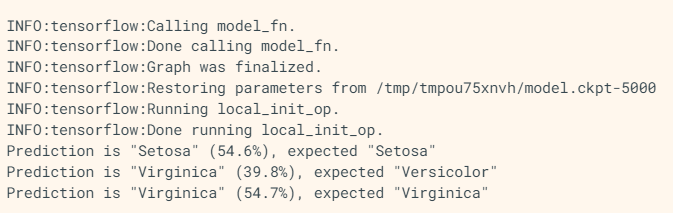
for pred_dict, expec in zip(predictions, expected):
    class_id = pred_dict['class_ids'][0]
    probability = pred_dict['probabilities'][class_id]

    print('Prediction is "{}" ({:.1f}%), expected "{}"'.format(
        SPECIES[class_id], 100 * probability, expec))
The upshot looks like this
 Naixian Zhang