Partial Differential Equation(PDEs) is an equation relating a multivariate function and various partial derivatives of u. For example, heat equation u is dependent on it’s space x and time.
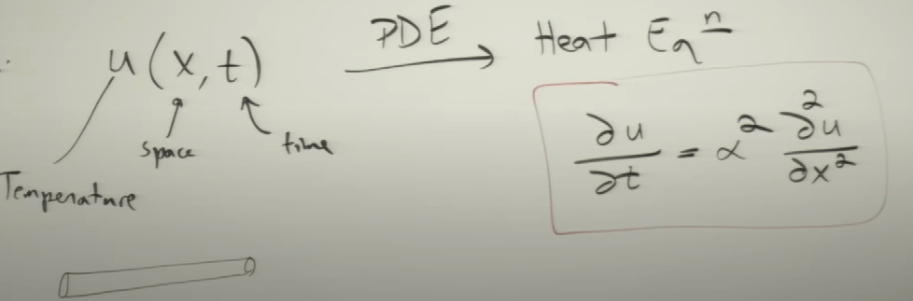
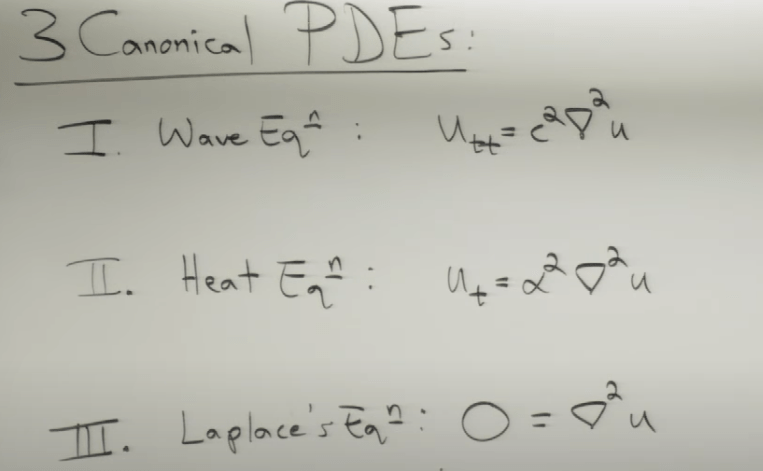
These are linear homogeneous. What are nonlinear?

- sin or cos, because they are Taylor series in power format, so they are not linear either.
- products such as u*ux
- absolute value
- Berger’s equation for shock wave problems
Now heat equation, first solved by Fourier. Start from a simple case – uniform evenly solid circular rod, we need to find out the rate of heat change in time at every point x:
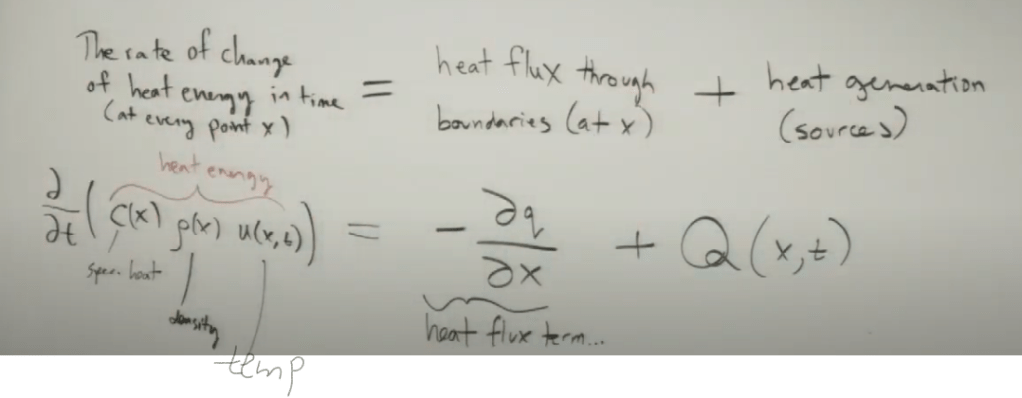
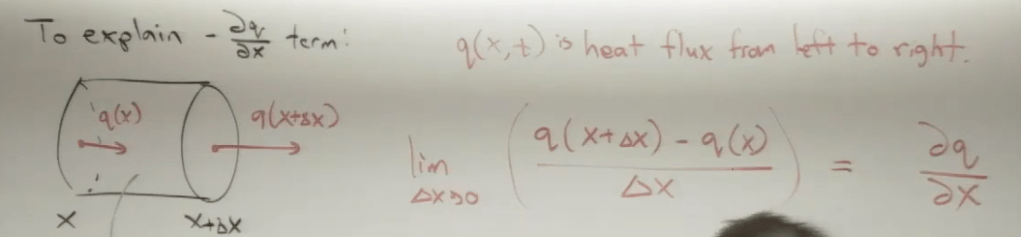
premise, it’s a very insulated rod on outer surface.
Next, how does the q dependent on temperature u?
Fourier’s observation:
if it’s uniform temperature, u=constant, then no heat flux(q=0)
if heat flux is positive, form higher to lower u, and heat flux is proportional to delta u.
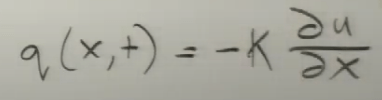
Therefore, plug it back, we get the below general form of heat equation:

Assume C(x), Lu(x), K(x) are all constant, Q is none, we get
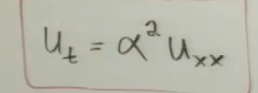
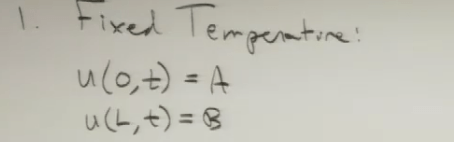
Now to solve, we need initial conditions u(x, 0) = f(x) , bounding conditions what happens at x = 0, x =l?
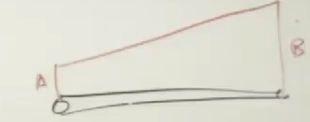
case 1, fixed temperatures on two end
assume it reaches equilibrium, so Ut = 0, hence Uxx = 0, this is the Laplace equation in 1D space. it’s a simple derivative computation, we get Ux = C1, U = C1x + C2,
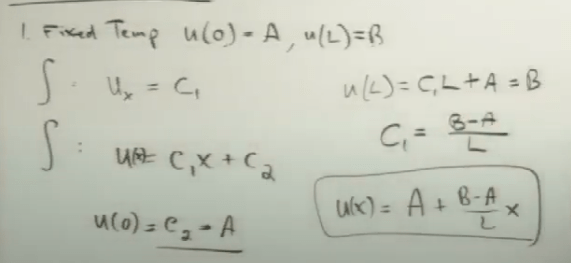
picturize it
case 2, both ends are insulated, so when time passes by, the temperature wont’ change Ux(0, t) = 0, Ux(L, t)=0.
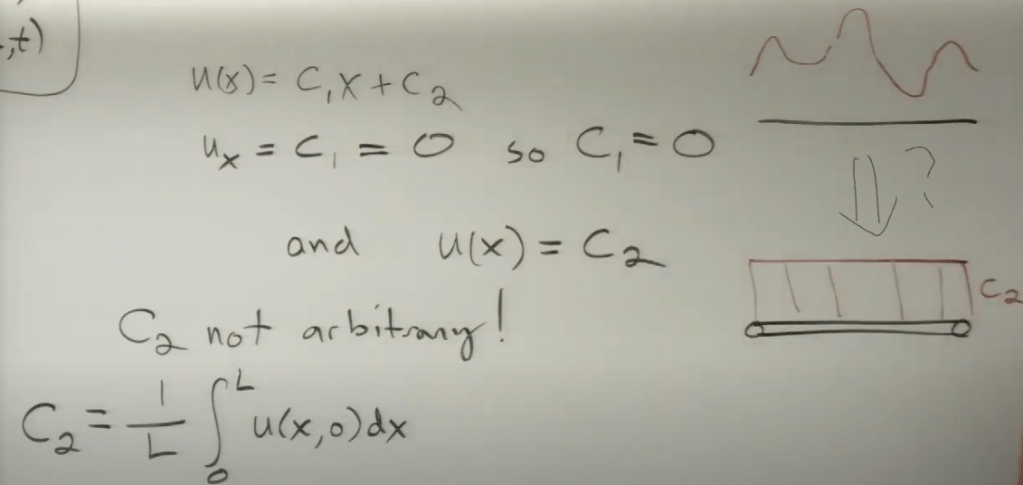
After computation, we know that at equilibrium, a rod with both ends insulated will reach a constant temperature C2, which is the average of initial input temperature at each position point.
Next study the heat diffusion in 2D or 3D nD space
Separation of Variables
u(x, y) can be broken up into some functions purely composed of x and of y u(x, y) = F(x)G(y).
Then plug in Laplace’s equation (uxx + uyy=0) and boundary conditions to find F(x) and G(y).
FxxG + FGyy = 0
so Fxx/x = -Gyy/G = constant
Jacob Bernerlu in 1690, 100 years before Fourier.
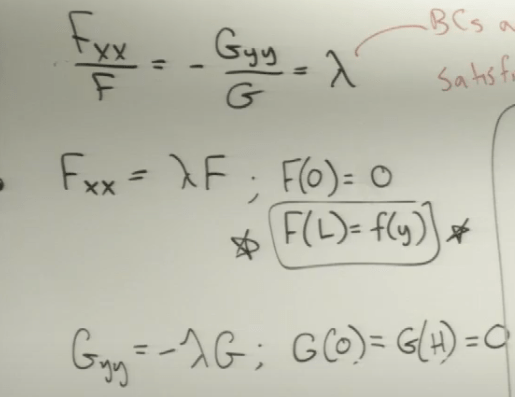
Before solving by math, use intuition to guess what the solution is. by the way what is sinh,

Now try to solve Gyy = -lambdaG, case 1 lambda is positive, case2 lambda is negative
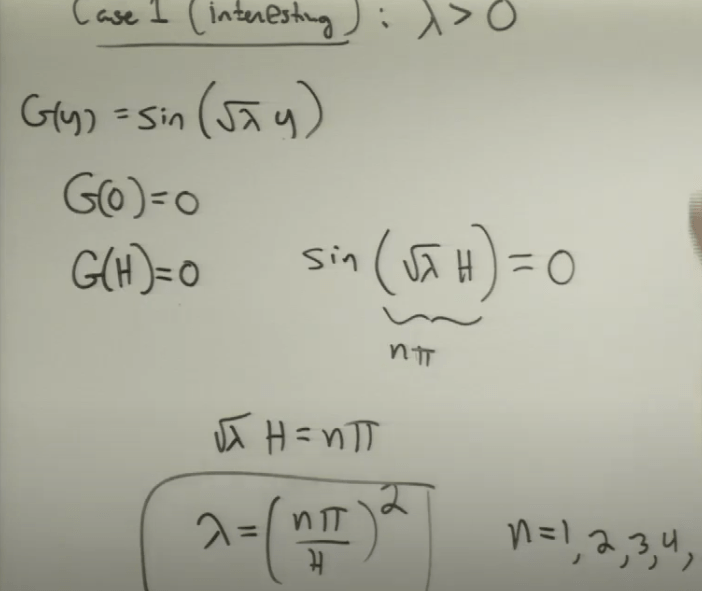
in case2, we’ll have to turn to exponential functions and then we find it will never satisfy boundary conditions. hence no solutions.
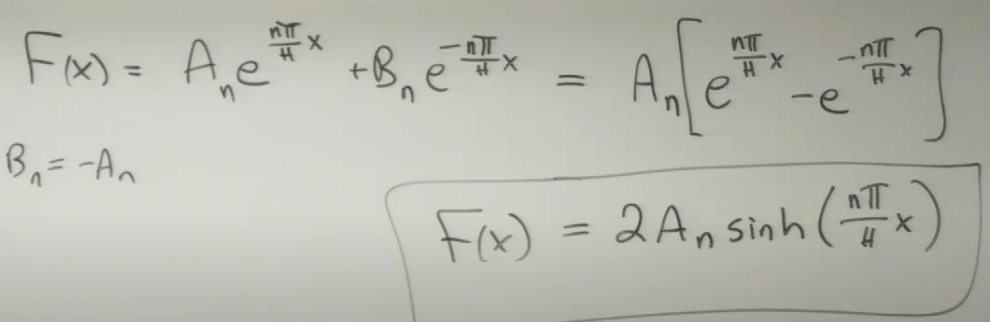
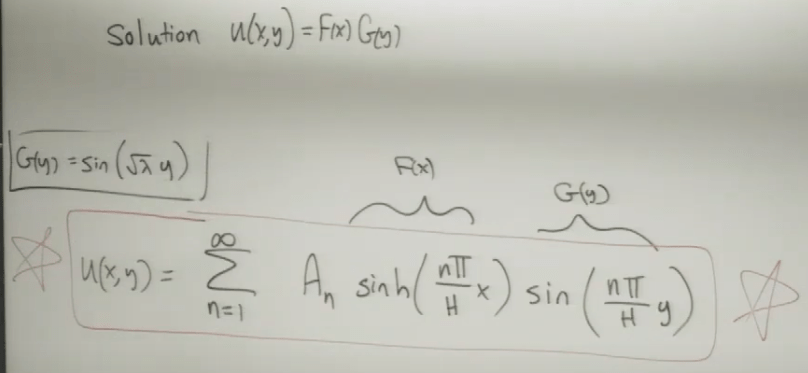
Lastly we need to find An.
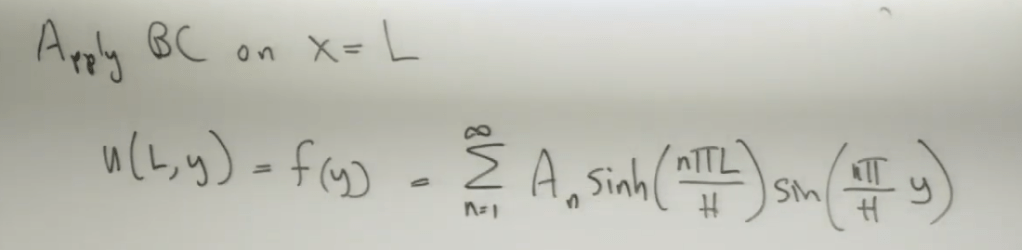
Conclusion

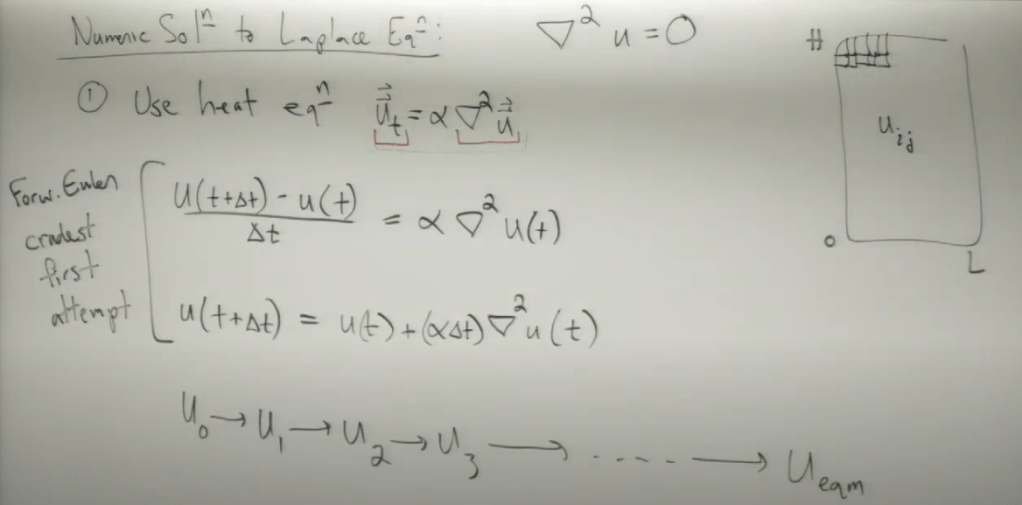
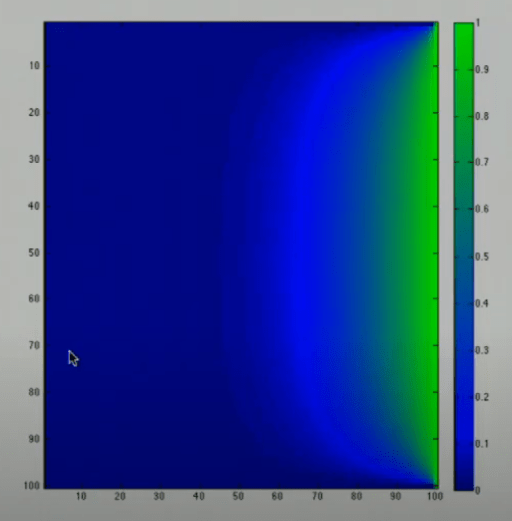
Now the math solution is deduced, we can also try the crude numerical integral approach:
 Naixian Zhang