Famous e^(ipie) = -1, why?
Form the following visual, premised on m reaches to the infinite big number, and geometry a complex number times another complex number is basically fold upon another the area.
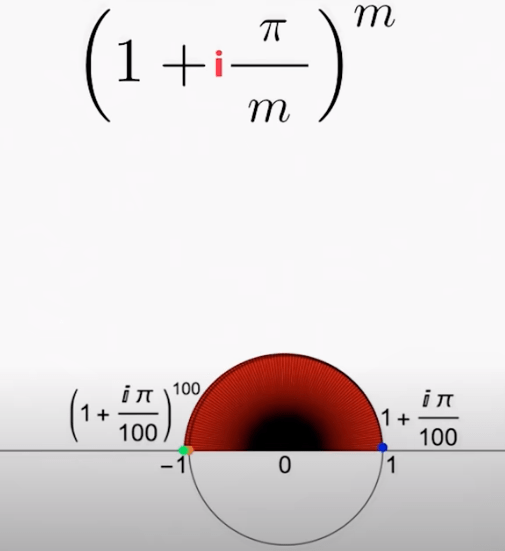
according to the nature of e (as is deduced from investing in bank one dollar with an annual interest rate of 100%=1, if you can collect that interest rate based on infinite small amount of period the total maximum money one can collect is
e = (1+1/m)^m = 2.3…; or more generic form for interest = r, period = T, then the amount is e^rT = (1+rT/m)^m.
when r, T belong to real number, it’s intuitive.
When r, T belong to imaginary number, composed of complex number the geometric depiction is right as above.
Hence, we really like this property of e Raised by any arc length(pie as unit) time i because it represents a Dot on the Circle so conveniently.
This way to understand e to the power of an imaginary number times pie(or any other real values) is intuitive but not the most complete. According to 3B1B, the ultimate interpretation of e to the power of something (something could be real number, imaginary number, matrix or even derivative…) is the polynomial equation:

If you plug in the matrix diagonal pie and pie as below, it will reach to a constant value of identify matrix.

 Naixian Zhang