This is my test project using LaTex provided by Overleaf. According to wiki, “often stylized as LATEX) is a software system for document preparation”. It’s a mark up language. Further, I will try “Writing LaTeX Documents In Visual Studio Code With LaTeX Workshop”. Not only I can use the VS code single platform to work on, but also it allows me to sync with web-based editors like Overleaf, and have satisfying versioning and backup. Note but since LaTex never touch $path setting, this is thrown me off since I have to manually edit $path variable.
As of now I will just use Overleaf and save file on the go. The most important is learn the basics of LaTex. These basics are: add figures, add tables, add comments and track changes, add list, change the margins and paper size, add Citations and a References List and most importantly, write math formulas.
In the very beginning, we will cite packages:
\documentClass{article}
\usepackage[utf8]{inputenc}
\usepackage{amsmath, amsthm, amsfonts}
\usepackage{graphicx}
\newtheorem{theorem}{Theorem}[section]
\newtheorem{corollary}{Corollary}[theorems]
\newcommand{\R}{\mathbb{R}}
\usepackage[margin=1in]{geometry}

\indent
\begin{multline}
\newpage

\setlength{\parskip}{5mm}
\setlength{\parindent}{0pt}
1. Adding figures are easy, first you need to upload the graph, then apply the following commands:
\begin{figure}
\centering
\includegraphics[width=0.3\textwidth]{frog.jpg}
\caption{\label{fig:frog}This frog was uploaded via the file-tree menu.}
\end{figure}
2. Adding tables,
\begin{table}
\centering
\begin{tabular}{l|r}
Item & Quantity \\hline
Widgets & 42 \
Gadgets & 13
\end{tabular}
\caption{\label{tab:widgets}An example table.}
\end{table}
3. Adding list
\begin{enumerate}
\item Like this,
\item and like this.
\end{enumerate}
\dots or bullet points \dots
\begin{itemize}
\item Like this,
\item and like this.
\end{itemize}
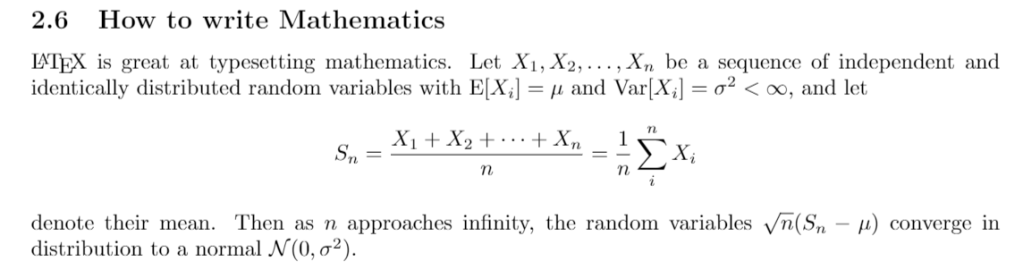
Lastly about writing math:
\subsection{How to write Mathematics}
\LaTeX{} is great at typesetting mathematics. Let $X_1, X_2, \ldots, X_n$ be a sequence of independent and identically distributed random variables with $\text{E}[X_i] = \mu$ and $\text{Var}[X_i] = \sigma^2 < \infty$, and let
[S_n = \frac{X_1 + X_2 + \cdots + X_n}{n}
= \frac{1}{n}\sum_{i}^{n} X_i]
denote their mean. Then as $n$ approaches infinity, the random variables $\sqrt{n}(S_n – \mu)$ converge in distribution to a normal $\mathcal{N}(0, \sigma^2)$.
 Naixian Zhang