Once again, I’m faced with a fresh territory to delve into – Green’s function. In 1828, Green wrote a pioneering paper titled “An Essay on the Application of Mathematical Analysis to the Theories of Electricity and Magnetism.” This paper introduced what we now call Green’s functions.
Nathan Kutz taught in an intuitive way by comparing Ax = b to Lu = f, f is the function of x.
According to ChatGPT, Green’s function can be thought of as the “response” of a system to a very specific “poke” or “impulse” at a particular point.
Mathematically, systems are often described by differential equations. Some of these equations can be tough to solve directly, especially when the “forcing” or “input” to the system is complex. But if we know the system’s response to a simple impulse (i.e., the Green’s function), we can use that knowledge to build the solution for any input.
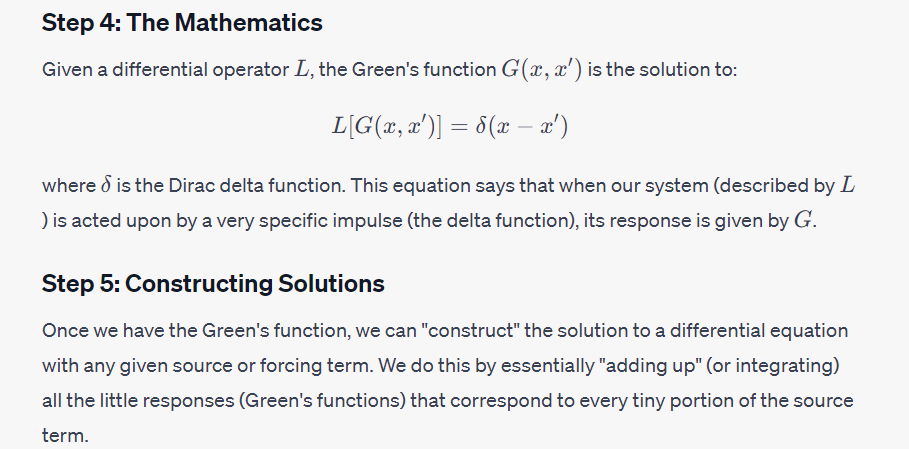
Consider a simple ODE example,
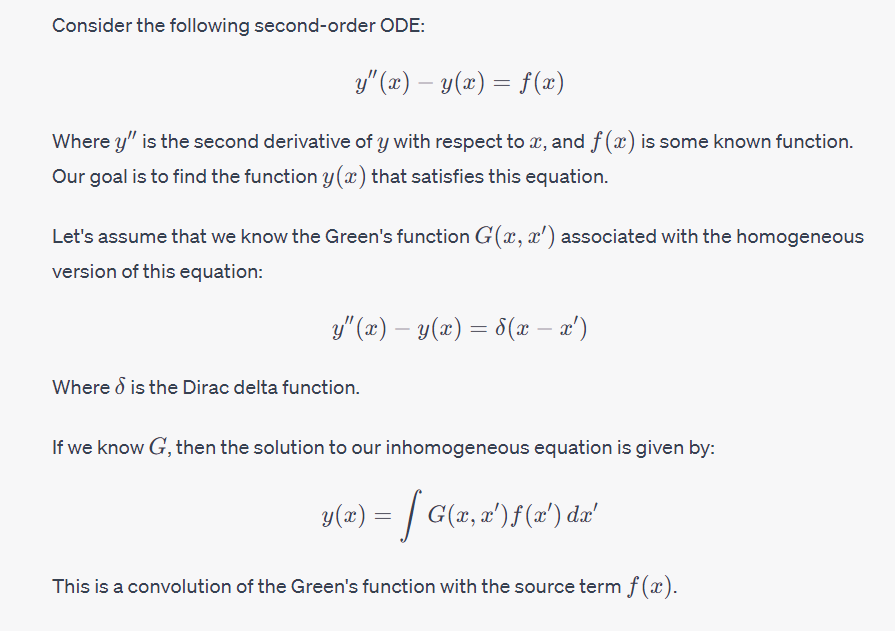
To convert to a problem of delta function is a mathematical way of representing a perfect impulse: a sudden and sharp “kick” to the system at a specific point. This “kick” is localized entirely at the point ′x′ and has no duration or width; it’s instantaneous and infinitely sharp.
By solving the equation with this impulse, the Green’s function tells us how the system responds to such a “kick” at any given point x′. Once we know that, as mentioned, we can predict the system’s response to more general disturbances or inputs.
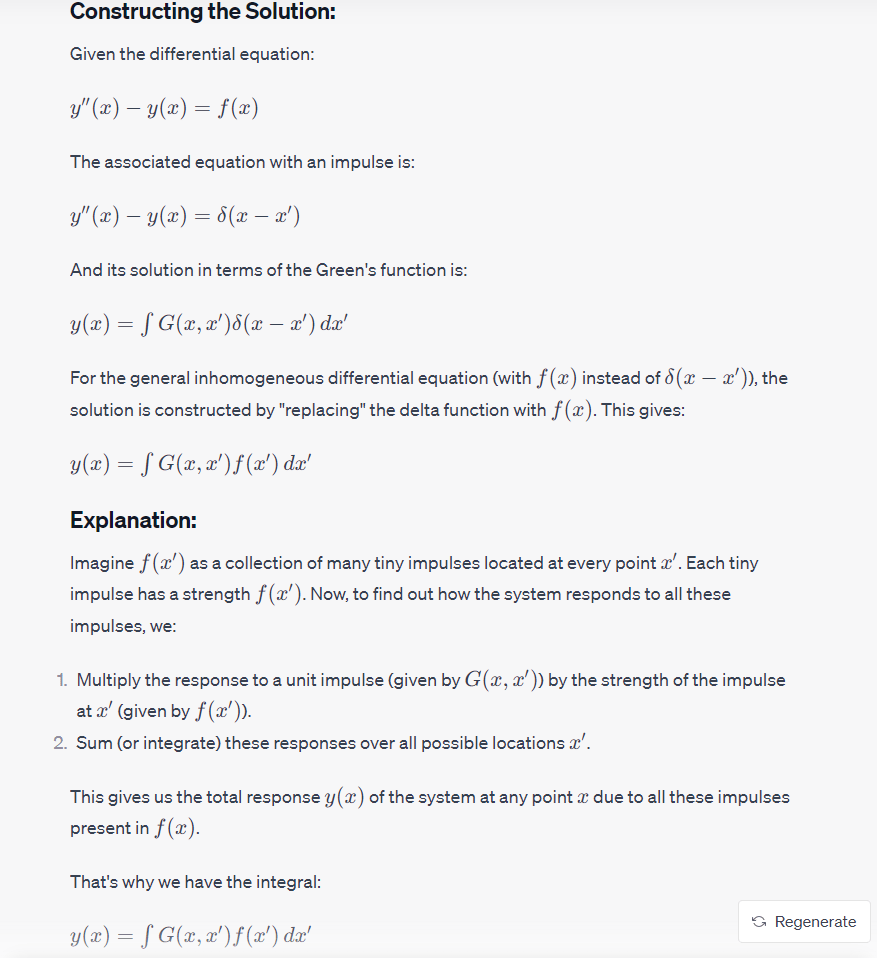
Nathan Kutz explain how to apply eigen expansion approach to solve Green’s funtion:


 Naixian Zhang