This equation is to describe vibration in physical world such as string vibration, the form is
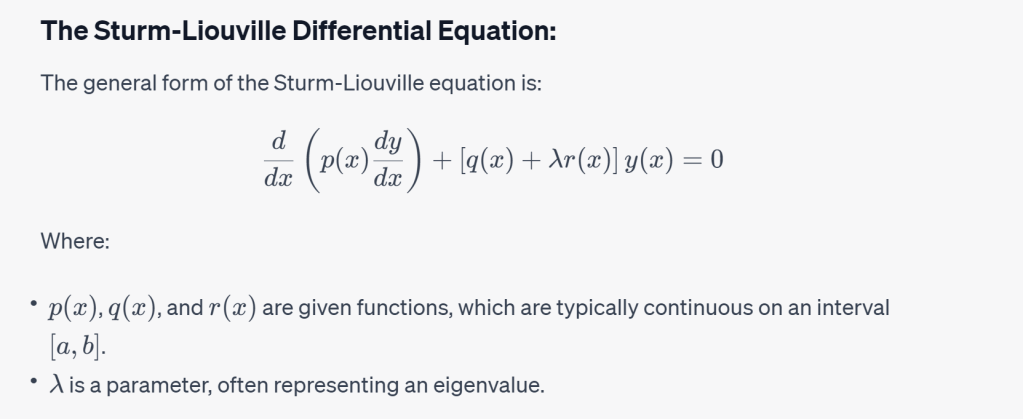
The equation itself isn’t “derived” in the traditional sense, but rather emerges as a result of solving various differential equations with boundary conditions.
However, a common way it comes about is from the process of seeking solutions to the one-dimensional wave equation or heat equation using separation of variables.
Origins in Vibrations: In the early 19th century, mathematicians and physicists were deeply interested in understanding the vibrations of systems, like strings and membranes. This led to differential equations that described these physical phenomena.
Work of Sturm and Liouville:
- Jacques Charles François Sturm (1803-1855): Sturm developed a theory concerning the number of real roots a polynomial equation possesses within certain bounds. This was then extended to the study of second-order linear differential equations, leading to what is now known as Sturm’s Comparison Theorem. This theorem gives information about the zeros of solutions to these differential equations.
- Joseph Liouville (1809-1882): Liouville extended the work of Sturm, particularly focusing on eigenvalue problems. His contributions helped to shape the formal structure of what we now recognize as Sturm-Liouville theory.
Connection to Eigenvalue Problems: The concept of eigenvalues and eigenfunctions is central to Sturm-Liouville theory. These ideas naturally emerge when trying to solve boundary value problems associated with differential equations. Over time, mathematicians realized that many problems in physics, especially those related to vibrations and waves, could be formulated as eigenvalue problems.
Formalization of the Theory: By the late 19th and early 20th centuries, the foundational ideas laid down by Sturm, Liouville, and others were further refined and systematized. The general form of the Sturm-Liouville differential equation, along with its properties and applications, became more clearly defined.
Applications in Quantum Mechanics:
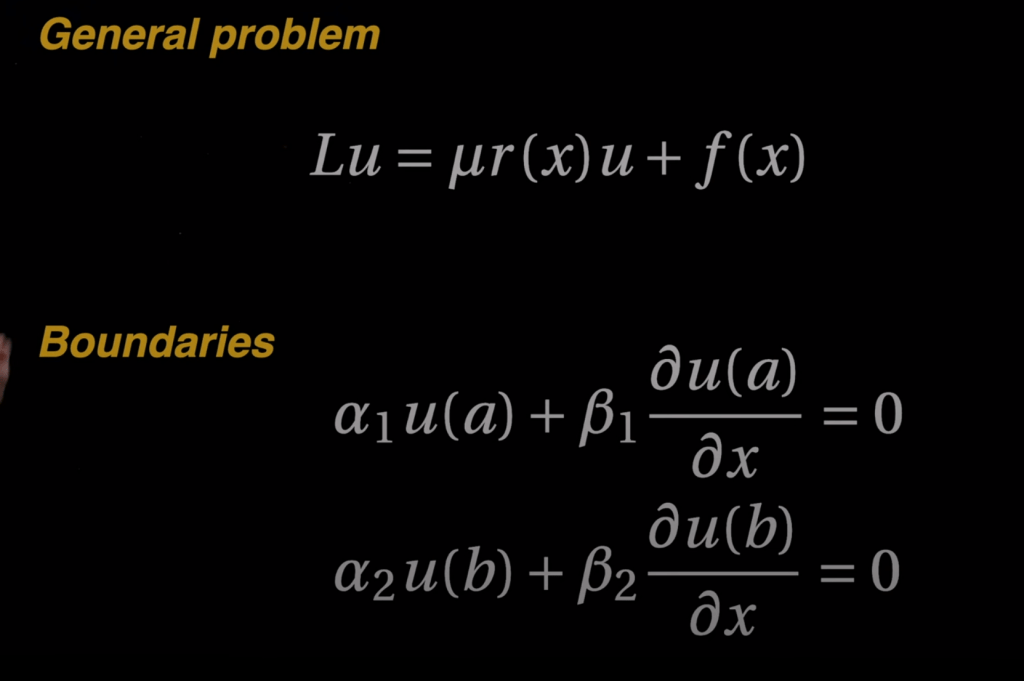
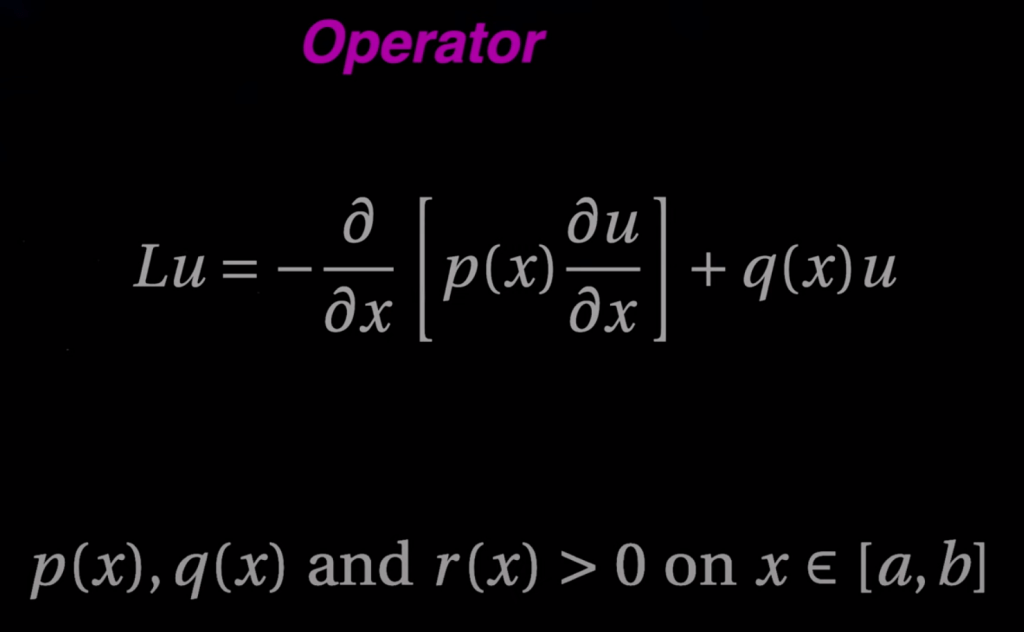

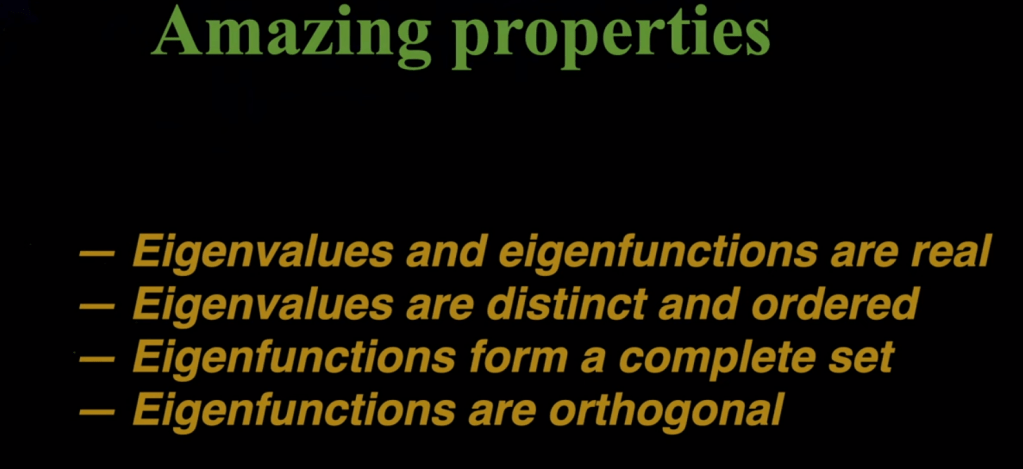
I’d like to learn how to apply this generic DE form to solve QM such as Schrodinger Problems?
 Naixian Zhang