Series by DrPhysicsA about Particle physics, with a question how particles are created from field? particles are understood as excitations or ‘ripples’ in their corresponding quantum fields that pervade all of space. For instance, we can think of an electron field. When this field is calm or at its lowest energy state (called the “vacuum state” or “ground state”), we observe no particles. However, when energy is added to the field, it excites the field and creates a disturbance, such as when you toss a stone into a calm pond and waves form. These excitations or disturbances are what we perceive as particles. In the case of the electron field, an excitation is perceived as an electron.
The Standard Model of Particle Physics is a successful theoretical framework because it has been extensively tested and has made accurate predictions about elementary particles and their interactions, including the existence of particles such as the Higgs boson before it was experimentally detected.
The force of electromagnetism is explained in the Standard Model through Quantum Electrodynamics (QED), which is a quantum field theory of electromagnetism. QED describes how light (photons) and matter (specifically, charged particles like electrons and quarks) interact.
Here’s a simplified version of how it works:
- All particles are surrounded by an electromagnetic field. When a charged particle moves, it disturbs this field, creating waves (photons).
- A particle can absorb a photon, which imparts energy and momentum to the particle and changes its trajectory. Thus, a force is exerted.
- Fundamentally, electromagnetism arises from the exchange of these photons between charged particles.
What makes the Standard Model particularly successful is its ability to incorporate QED, alongside the theories of the weak and strong nuclear forces, into a single coherent framework. It’s successful in the sense it provides an incredibly accurate prediction of the behaviors and properties of these particles and forces, up to the limits of current experimental precision.
However, the Standard Model isn’t perfect or complete – it doesn’t include gravity, for example, nor does it explain dark matter or dark energy, which are thought to make up the majority of the universe’s mass and energy. These are some of the challenges that today’s physicists are actively working to address.
- Creation and annihilation operators, fields and particles
- Angular Momentum and Spin
- Rotation Operators SU(3)xSU(2)xSU(1)
- Gauge Theory, Symmetry and Higgs
In DrPhysicsA’s deduction, it’s quite a lot of math manipulation, so the Hamiltonian below
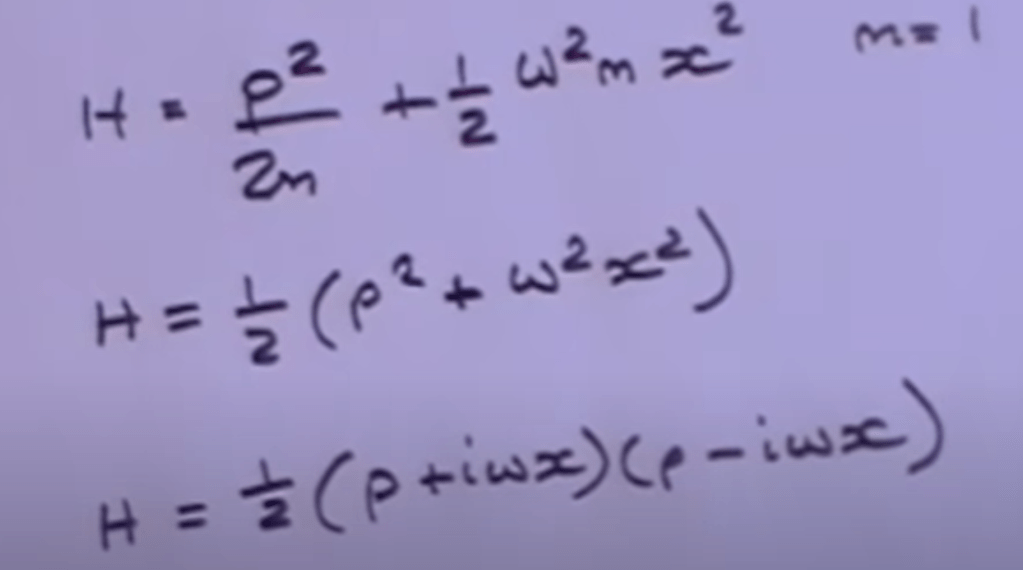
Then we call a+ and a- as following, and they are creation and annihilation operators.


In Quantum field, the sai operators are
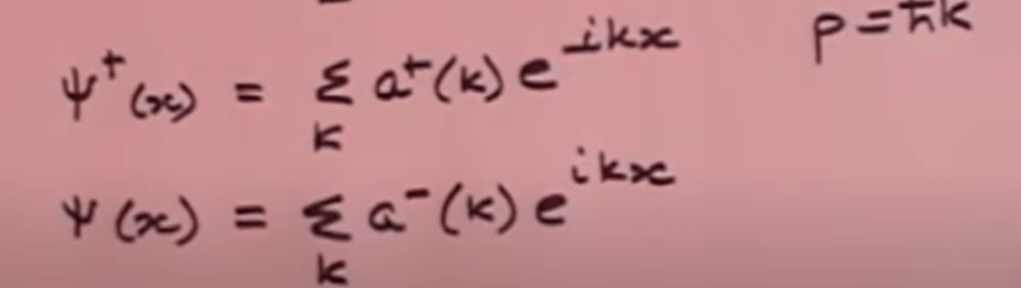
adding time parameters in

Fermions are electrons, neutrons and quarks, bosons are photons, W&Z, gluons, gravitons and Higgs. The Pauli exclusion principles apply to fermions but not to bosons.
Deriving and come up with the Fermi Sea concept, then Dirac brilliantly assume there are negative K, negative E all filled up to the left side, and if photon comes and excited electrons to the right end, those filled place become holes, and are positrons, which are vindicated by experiment discovery of positrons.
Combining special relativity and Quantum Mechanics,
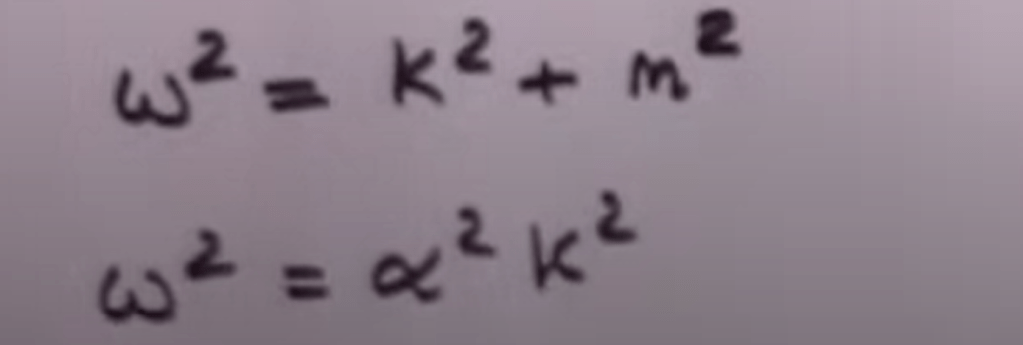
Dirac equations

 Naixian Zhang
Excellent post 🙏🙏
LikeLike