Bitwise Asset Management is the largest crypto index fund manager in America. Thousands of financial advisors, family offices, and institutional investors partner with Bitwise to understand and access the opportunities in crypto. For six years, Bitwise has established a track record of excellence managing a broad suite of index and active solutions across ETFs, separately managed accounts, private funds, and hedge fund strategies. Bitwise is known for providing unparalleled client support through expert research and commentary, its nationwide client team of crypto specialists, and its deep access to the crypto ecosystem.
under the tab of investment:
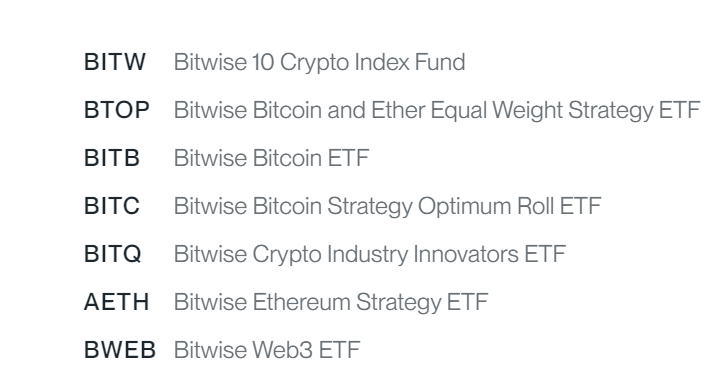
ETFs are
SMA strategies are

Active Strategy
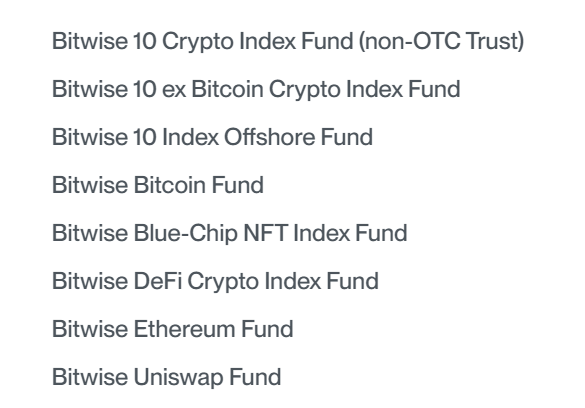
Private funds are
The Bitwise 10 Crypto Index Fund (BITW) seeks to track the Bitwise 10 Large Cap Crypto Index, which selects the 10 largest cryptocurrencies based on a rules-based methodology. The key aspects of the methodology are:
- Constituents are selected based on free-float-adjusted market capitalization, with additional eligibility criteria around trading volume, custody availability, regulatory status, and other factors to ensure investability.
- The index captures the 10 largest eligible crypto assets by free-float-adjusted market capitalization.
The index is reconstituted and rebalanced monthly to reflect changes in the crypto markets.
- Crypto assets in the fund are held in 100% cold storage with multi-signature security configurations by a third-party qualified custodian (currently Coinbase Custody).
- The fund’s holdings are audited annually by a reputable auditor (currently KPMG).
The methodology aims to provide a rules-based, transparent way to track the performance of the largest cryptocurrencies while accounting for factors unique to crypto assets like liquidity, security, and custody limitations
The Bitwise Ethereum Strategy ETF (AETH) , rather than tracking an index of Ethereum spot prices, AETH aims to provide Ethereum exposure through actively managed positions in regulated Ether Futures Contracts on the CME.
One specific offering is the Bitwise Multi-Strategy Alpha Fund, a multi-manager fund that provides diversified exposure to liquid digital asset strategies. Key points:
- Targets exceptional risk-adjusted returns across crypto cycles
- Aims for lower volatility and correlation to Bitcoin (0.2-0.3 beta to BTC)
- Invests in established crypto hedge funds running various strategies like event-driven, arbitrage, quant, etc.
- Can allocate up to 20% to opportunistic direct investments and hedging overlays
The multi-strategy solutions are actively managed by a team of portfolio managers, risk analysts, and operational due diligence experts with experience across crypto, hedge funds, and traditional finance. The approach combines crypto-native expertise with rigorous risk management practices.The goal is to provide institutional investors with thoughtful, diversified exposure to crypto’s evolving opportunities through top managers, while emphasizing risk controls and liquidity management.
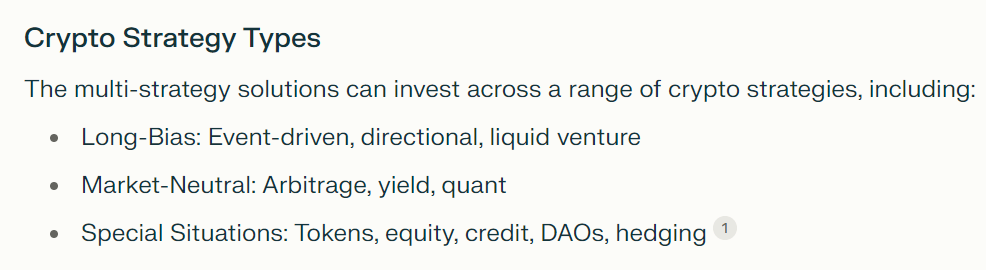
In the crypto arena, here are some of the key statistical arbitrage strategies employed:
Cross-Exchange Arbitrage
This involves exploiting price discrepancies of the same cryptocurrency across different exchanges. Traders buy the crypto asset on the exchange where it is trading at a lower price and simultaneously sell it on another exchange where the price is higher, profiting from the price difference.For example, if Bitcoin is trading at $28,000 on Coinbase and $28,200 on Kraken, an arbitrageur could buy Bitcoin on Coinbase and immediately sell it on Kraken, capturing the $200 price gap as profit (minus fees).
Triangular Arbitrage
This strategy takes advantage of pricing inefficiencies between three different cryptocurrencies on a single decentralized exchange (DEX).Traders identify mispriced ratios between the three assets and execute a series of trades cycling through the three assets to profit from the price discrepancies, ending up with more of one asset than they started with.
Derivatives Arbitrage
This involves exploiting pricing gaps between spot and derivatives markets for the same crypto asset, like perpetual futures contracts.If the futures price diverges too far from the spot price, arbitrageurs can buy the underpriced asset and sell the overpriced one to capture the mispricing.
Flash Loan Arbitrage
This advanced strategy utilizes flash loans (uncollateralized crypto loans) to execute complex, multi-transaction arbitrage trades with no upfront capital required.Traders take out a flash loan, leverage it across multiple DEX trades to profit from temporary price inefficiencies, and repay the loan plus fees in one atomic transaction.The key advantage of statistical arbitrage in crypto is the ability to rapidly identify and trade on pricing inefficiencies across many markets using algorithms and bots before prices re-converge. However, risks include high fees, execution delays, and market volatility impacting trade profitability.
In the crypto space, statistical arbitrage strategies have been adopted by specialized crypto trading firms, quant funds, and automated trading systems (bots) to exploit pricing inefficiencies across the fragmented crypto exchange landscape.The ability to rapidly identify and trade pricing dislocations between exchanges, derivatives markets, and crypto assets makes statistical arbitrage an attractive approach for crypto traders and funds with the requisite technological capabilities.While the core principles remain the same, the application of statistical arbitrage in crypto involves unique challenges like high volatility, fragmented liquidity, and evolving market dynamics compared to traditional asset classes. Nonetheless, the crypto markets’ relative immaturity and inefficiencies have made them fertile ground for deploying these data-driven arbitrage strategies by sophisticated players.
 Naixian Zhang