I recently became intrigued by Quantum Field Theory, including topics like local and global gauge invariance, and decided to fully immerse myself in this course. Alex’s course is the best I have found so far. It is deeply upsetting to learn that he has passed away due to a brain tumor. The world has lost a truly great human being.
First, fundamental particles/fields can be broken down to three categories, one is force particles, or mediators, gauge bosons, within force mediators, there is photon in EM, w plus and minus, Z zero for weak force, and 8 gluons in strong interactions. The other category is matter, made of fermions, spin half, further fermions has leptons and quarks, there are flavors, doublets and antiparticles, in total 48 kinds. the third one god particle – Higgs. This basically is the Standard Model.
Note strong interaction the 8 gluons only touches quarks, while the weak force mediators only on leptons. Terms like hedrons are combination of quarks, two quarks is called mesons, three quarks forms Baryons. they then form protons and neutrons, they are stable while mesons are not stable. that’s why the world we’re familiar with protons and neutrons.
The course is composed of two parts: formalism and calculation.
In formalism the basic is about symmetry, group theory. What is the definition of representation? the term “representation” often refers to the concept of representing abstract structures such as groups, algebras, or other mathematical entities in a concrete form, usually as matrices or operators acting on a vector space. For example, rotation in a plane that carries square to square, there are three representations as
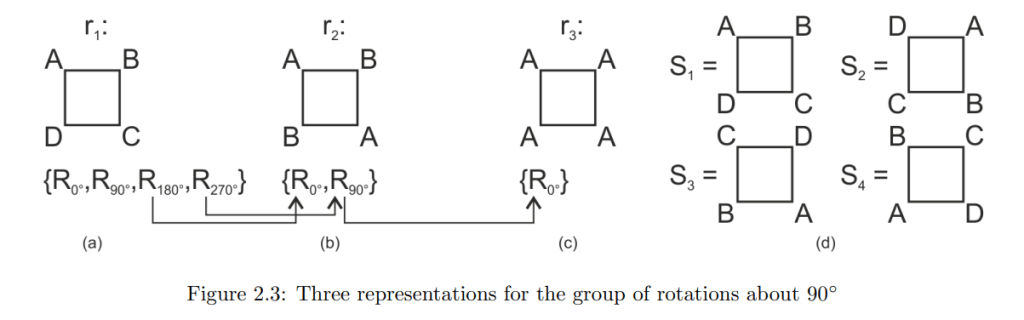
The first one is called faithful representation, the second is degenerate representation and third is identity representation.
Z2 = {I, g} w g squared = I Groups can have various forms or representations.
SU(N) = N^2 – 1
SU(1) free degree is 1, photon, SU(2) free degree is 3, corresponding to w plus and w minus and z zero, SU(3) free degree is 8, corresponding to the 8 gluons.
quark: is spinor of SO(1, 3), a vector of SU(3), a vector of SU(2), a vector of U(1)
w plus: is a vector of SO(1, 3), a scalor of SU(3), adjoint of SU((2), a vector of U(1)
 Naixian Zhang