projective representation of a group is a generalization of the usual (linear) representation. Instead of mapping group elements to linear transformations directly, projective representations map group elements to linear transformations up to a phase factor, it’s definition should be understood by comparing to ordinary/linear representation

Phase Factors in Quantum Mechanics
- In quantum mechanics, the state of a system is represented by a vector in a Hilbert space, but physically observable quantities are unaffected by a global phase factor.
- Consequently, transformations on quantum states can often be described by projective representations rather than ordinary representations.
SU(2) and SO(3)
- The group SU(2) (the group of 2×2 unitary matrices with determinant 1) has a well-known projective representation on the group SO(3) (the group of rotations in 3-dimensional space).
- Elements of SO(3) can be represented by SU(2) matrices up to a sign, leading to a projective representation.
fundamental group is a concept from algebraic topology that captures the idea of loops in a topological space and how these loops can be transformed into one another.
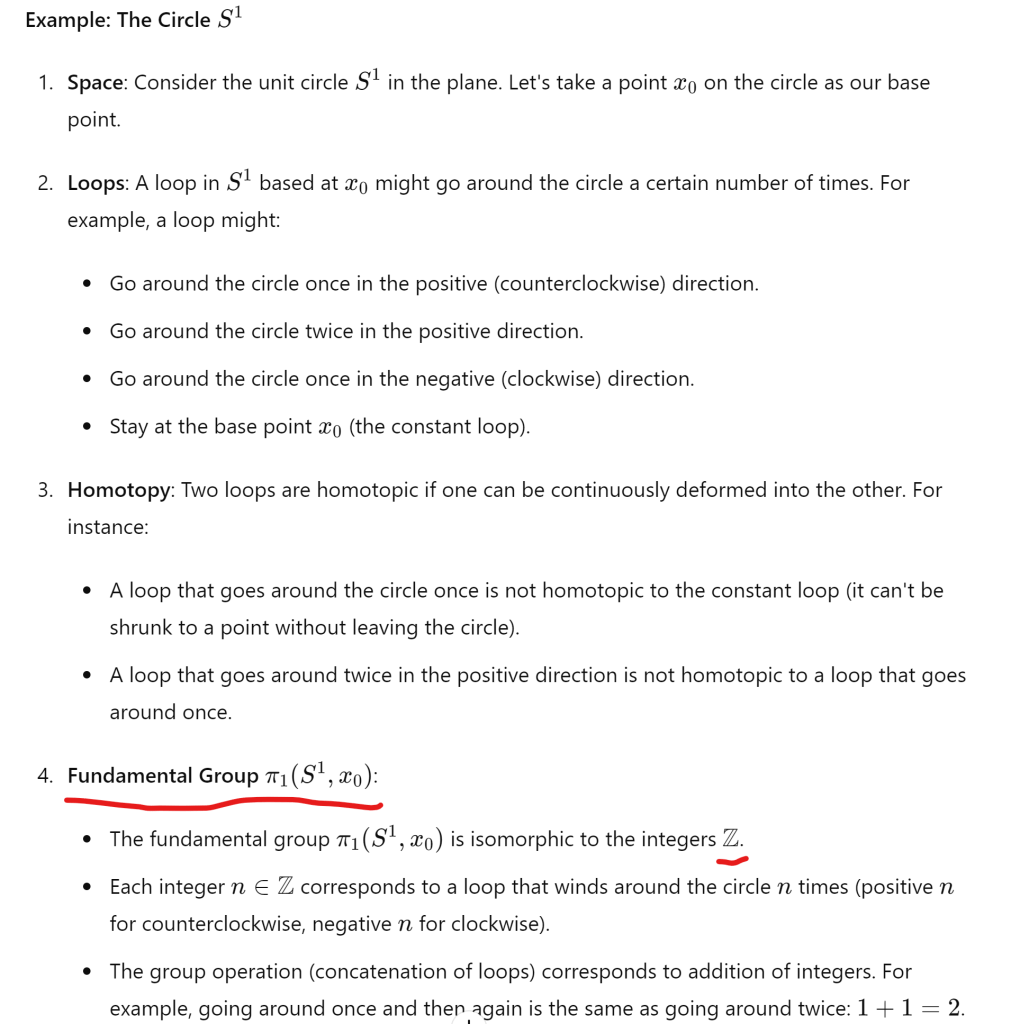
Why it’s so useful, he fundamental group helps in understanding the shape and structure of a space. It tells us about the “holes” in the space: A space with a non-trivial fundamental group has one or more “holes”. A space with a trivial fundamental group (only the identity element) has no “holes” that loops can wrap around.
The fundamental group of the rotation group SO(3)SO(3)SO(3), which represents the group of all rotations about the origin in three-dimensional space, is isomorphic to the cyclic group of order 2, denoted by Z2\mathbb{Z}_2Z2.
 Naixian Zhang