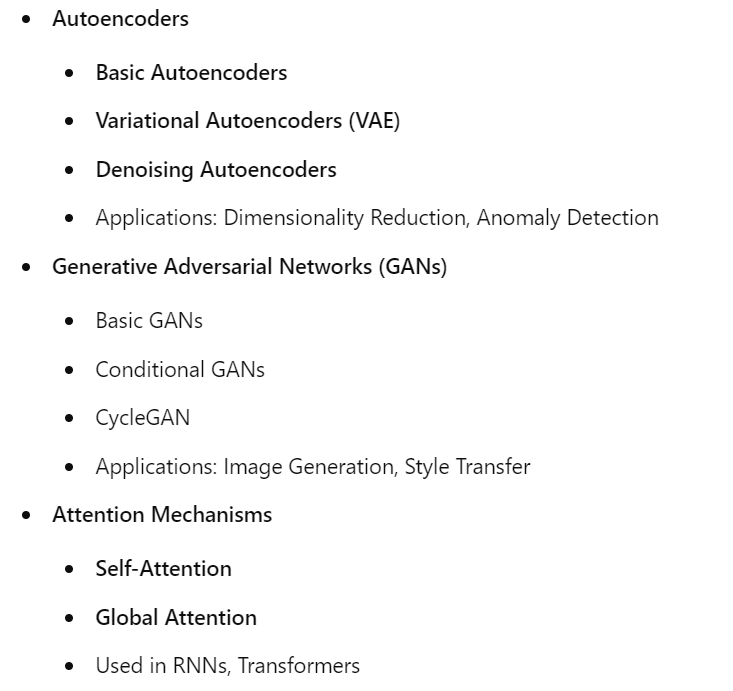
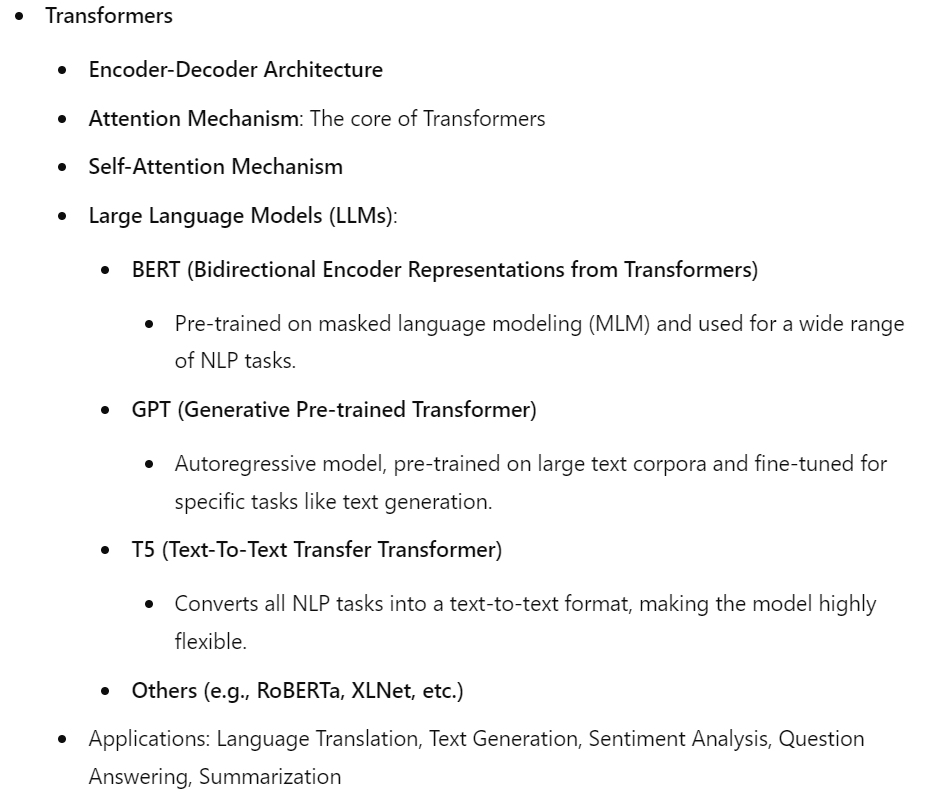
Hierarchy of Neural Network Architectures:

Dive deep into this paper: Attention is all you need, particularly to understand below concepts:
Positional Encoding:
Layer Normalization: Layer normalization is a technique used to stabilize and accelerate the training of deep neural networks by normalizing the inputs across the features in a layer. It was introduced as an alternative to batch normalization, particularly useful in scenarios where batch sizes are small or the model is recurrent, like in NLP tasks. beta starts as zero, but during training, it can be adjusted (via backpropagation) to shift the normalized output.
Scaled Dot-Product Attention is a key component of the Transformer architecture used in modern natural language processing models like BERT, GPT, and others. Intuitively, it’s a mechanism that allows a model to focus on different parts of the input data (such as a sentence) with varying degrees of importance when making predictions or understanding context.
Residual connection (also known as a skip connection) is a technique used in neural networks to address the problem of vanishing or exploding gradients, which can make training deep networks difficult. It help solve the vanishing gradient problem.
Encoder is a part of a model architecture that processes and transforms input data into a different, often more compact, representation. Encoders are commonly used in various types of neural networks, particularly in sequence-to-sequence (Seq2Seq) models, autoencoders, and Transformers. n Transformer models, the encoder consists of multiple layers of self-attention and feed-forward networks. The encoder processes the entire input sequence in parallel, capturing relationships between all parts of the input through attention mechanisms. machine translation, an encoder reads a sentence in the source language and transforms it into a context vector. This context vector is then passed to a decoder that generates a translation in the target language.
Decoder is a crucial component that generates the output sequence (e.g., the translated text) from the encoded input sequence (e.g., the source language text). How the Decoder Works in a Transformer: The decoder in a Transformer architecture works in conjunction with the encoder, leveraging self-attention mechanisms and cross-attention mechanisms to generate the target sequence one token at a time. The decoder in a Transformer is responsible for generating the output sequence by attending to both the previous output tokens (through self-attention) and the encoded representation of the input sequence (through cross-attention).
Building a transformer model for translation involves several key components: the encoder, the decoder, and the attention mechanisms.
According to the paper, Our model achieves 28.4 BLEU on the WMT 2014 Englishto-German translation task, improving over the existing best results, including
ensembles, by over 2 BLEU. On the WMT 2014 English-to-French translation task,
our model establishes a new single-model state-of-the-art BLEU score of 41.8 after
training for 3.5 days on eight GPUs, a small fraction of the training costs of the
best models from the literature. We show that the Transformer generalizes well to
other tasks by applying it successfully to English constituency parsing both with
large and limited training data.
Hugging Face’s datasets library provides several datasets that can be used for training translation models between English and Italian. One of the most commonly used datasets for this purpose is the TED Talks dataset.
 Naixian Zhang