This is the first blog in a series to develop a comprehensive suite of codes for robot arm software that could potentially become a realistic application in life or industry usage.
main.py and robot_arm.py
# Import necessary libraries
import speech_recognition as sr
import spacy
from robot_arm import RobotArm  # Import the RobotArm module

# Initialize NLP model
nlp = spacy.load("en_core_web_sm")

# Initialize the robot arm with link lengths
robot_arm = RobotArm(link1_length=10, link2_length=10)

def listen_for_command():
    # Initialize the recognizer
    recognizer = sr.Recognizer()

    # Use the microphone as the source for input
    with sr.Microphone() as source:
        print("Listening for command...")
        audio = recognizer.listen(source)

    # Convert audio to text
    try:
        command_text = recognizer.recognize_google(audio)
        print(f"Command received: {command_text}")
        return command_text
    except sr.UnknownValueError:
        print("Could not understand audio. Please try again.")
        return None
    except sr.RequestError as e:
        print(f"Could not request results; {e}. Please check your network connection.")
        return None

def process_command(command_text):
    # Parse the command using NLP
    doc = nlp(command_text)

    # Extract the verb (action) and objects from the command
    action = None
    objects = []
    position = None

    for token in doc:
        if token.pos_ == "VERB":
            action = token.lemma_
        if token.pos_ in ["NOUN", "PROPN"]:
            objects.append(token.text.lower())
        if token.like_num:
            if position is None:
                position = [float(token.text)]
            else:
                position.append(float(token.text))

    # Define a dictionary of supported actions and their corresponding robot functions
    actions = {
        "lift": robot_arm.lift,
        "bring": robot_arm.bring,
        "move": robot_arm.move,
        "grab": robot_arm.grab,
        "put": robot_arm.put,
        "go": robot_arm.move_to_position
    }

    # Check if the action is supported and execute the corresponding function
    if action in actions:
        if action == "go" and position and len(position) == 2:
            print(f"Moving to position: ({position[0]}, {position[1]})")
            actions[action](position[0], position[1])
        elif objects:
            print(f"Executing: {action} {', '.join(objects)}")
            actions[action](*objects)
        else:
            print(f"Action '{action}' recognized, but no objects or position specified.")
    else:
        print(f"Action '{action}' not recognized. Supported actions are: {', '.join(actions.keys())}")

def main():
    while True:
        command_text = listen_for_command()
        if command_text:
            process_command(command_text)
        else:
            print("No valid command received. Listening again...")

if __name__ == "__main__":
    main()
import numpy as np
from scipy.linalg import expm, logm

class RobotArm:
    def __init__(self, link1_length, link2_length):
        self.link1_length = link1_length
        self.link2_length = link2_length

    def skew(self, v):
        """Convert a 3D vector to a skew-symmetric matrix."""
        return np.array([[0, -v[2], v[1]],
                         [v[2], 0, -v[0]],
                         [-v[1], v[0], 0]])

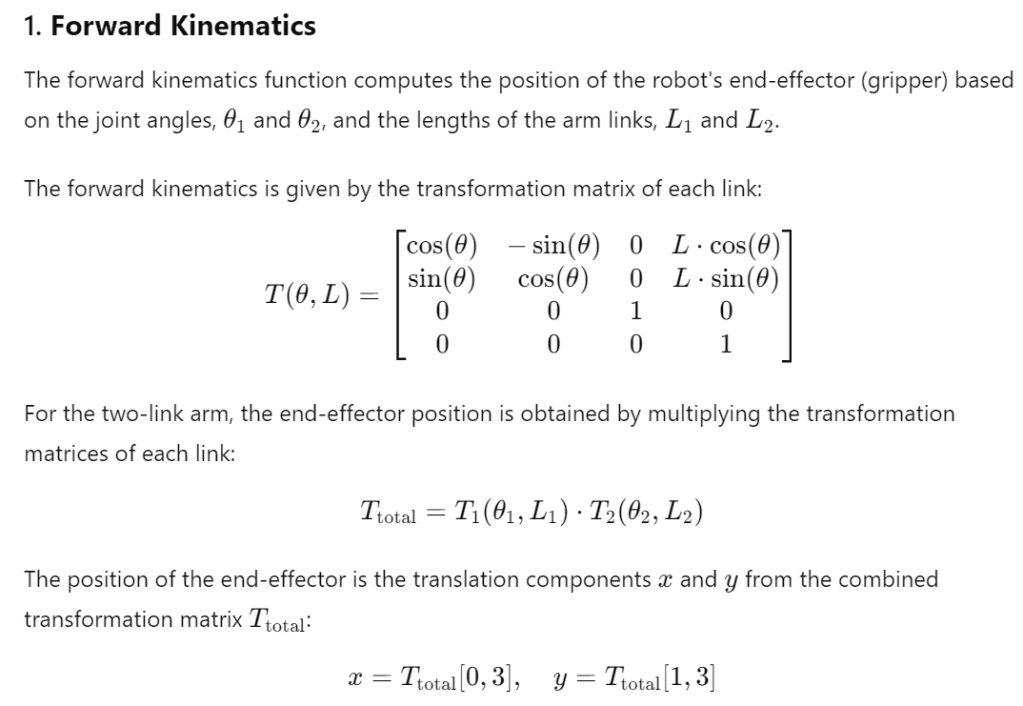
    def forward_kinematics(self, theta1, theta2):
        """Compute the end-effector position given joint angles."""
        T1 = self.joint_transform(self.link1_length, theta1)
        T2 = self.joint_transform(self.link2_length, theta2)
        T = np.dot(T1, T2)
        return T[:2, 3]  # Return x, y coordinates

    def joint_transform(self, length, theta):
        """Compute the transformation matrix for a joint."""
        c, s = np.cos(theta), np.sin(theta)
        return np.array([[c, -s, 0, length*c],
                         [s, c, 0, length*s],
                         [0, 0, 1, 0],
                         [0, 0, 0, 1]])

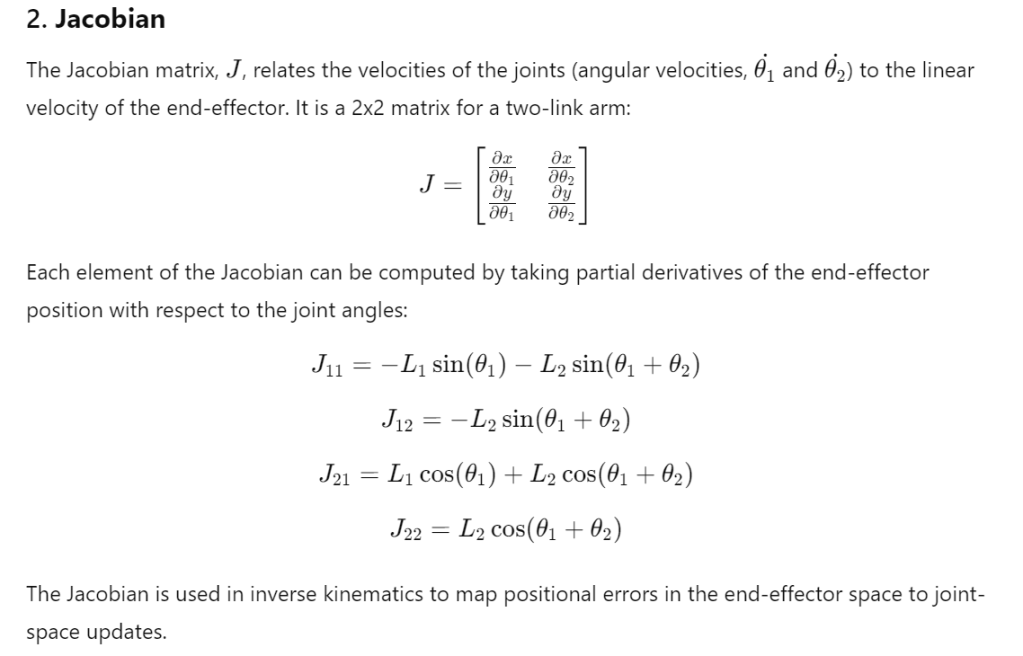
    def compute_jacobian(self, theta1, theta2):
        """Compute the Jacobian matrix."""
        J = np.zeros((2, 2))
        J[:, 0] = [-self.link1_length*np.sin(theta1) - self.link2_length*np.sin(theta1 + theta2),
                   self.link1_length*np.cos(theta1) + self.link2_length*np.cos(theta1 + theta2)]
        J[:, 1] = [-self.link2_length*np.sin(theta1 + theta2),
                   self.link2_length*np.cos(theta1 + theta2)]
        return J

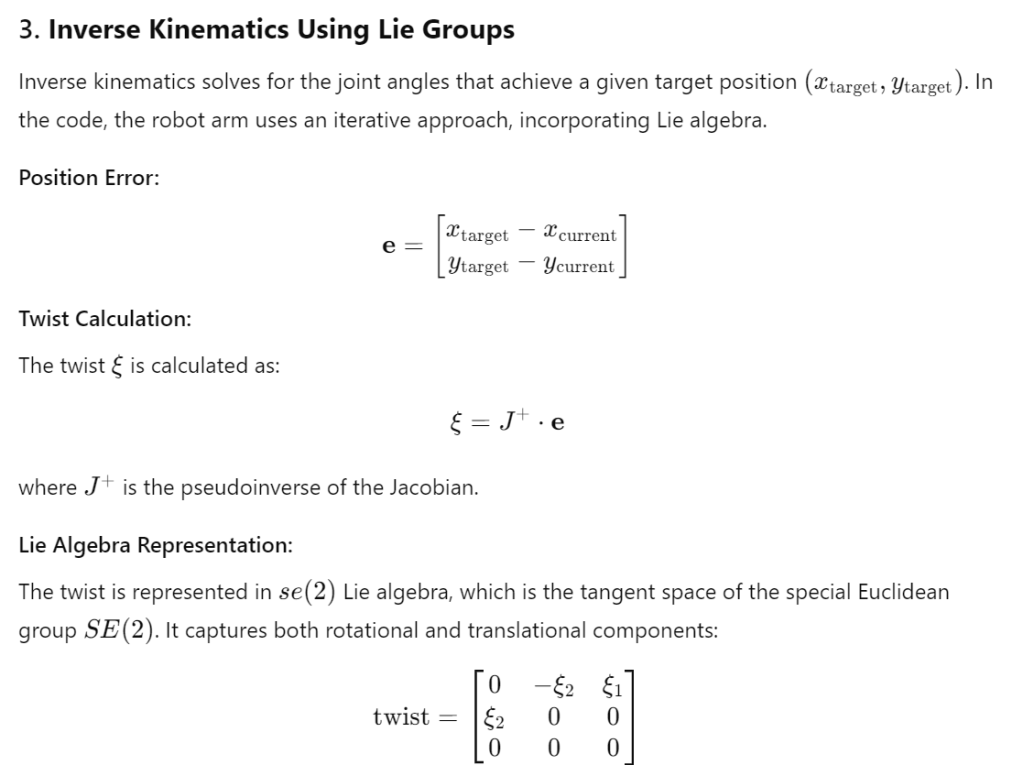
    def inverse_kinematics(self, target_x, target_y, max_iterations=100, tolerance=1e-3):
        """Compute inverse kinematics using Lie group methods."""
        theta = np.array([0, 0])  # Initial guess
        for _ in range(max_iterations):
            current_pos = self.forward_kinematics(theta[0], theta[1])
            error = np.array([target_x, target_y]) - current_pos

            if np.linalg.norm(error) < tolerance:
                return theta

            J = self.compute_jacobian(theta[0], theta[1])

            # Compute the twist
            twist = np.linalg.pinv(J) @ error

            # Convert twist to se(2) Lie algebra
            se2_algebra = np.array([[0, -twist[1], twist[0]],
                                    [twist[1], 0, 0],
                                    [0, 0, 0]])

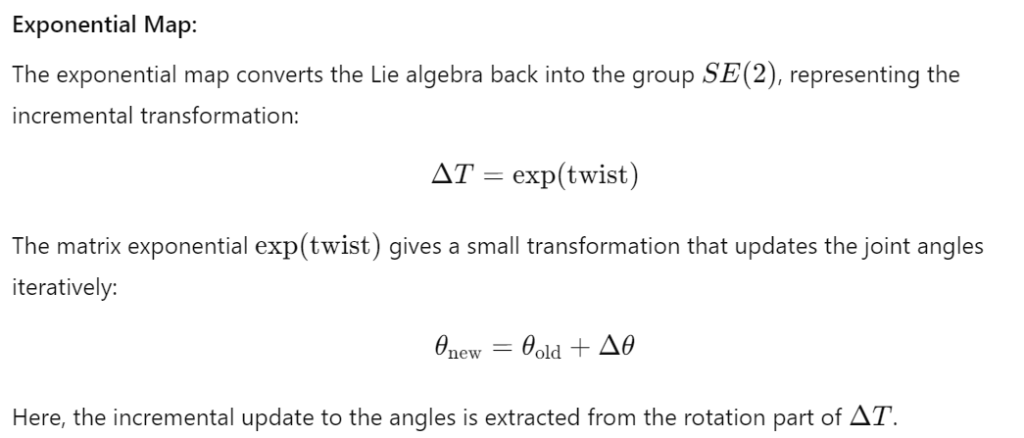
            # Compute the incremental transformation
            delta_T = expm(se2_algebra)

            # Extract the rotation part
            delta_R = delta_T[:2, :2]

            # Convert rotation to angle
            delta_theta = np.arctan2(delta_R[1, 0], delta_R[0, 0])

            # Update joint angles
            theta += np.array([delta_theta, delta_theta])

        print("Inverse kinematics did not converge")
        return None

    def move_to_position(self, target_x, target_y):
        angles = self.inverse_kinematics(target_x, target_y)
        if angles is not None:
            print(f"Moving to position ({target_x}, {target_y}) with angles: {np.degrees(angles[0]):.2f}°, {np.degrees(angles[1]):.2f}°")
            # Here you would add the code to physically move the robot arm
        else:
            print("Cannot move to the specified position.")

    def lift(self, *objects):
        for obj in objects:
            if self.is_within_reach(obj) and self.is_weight_supported(obj):
                print(f"Lifting {obj}")
                # Simulate the lifting process
                self.perform_lift(obj)
                print(f"{obj} has been lifted successfully.")
            else:
                print(f"Cannot lift {obj}. It may be out of reach or too heavy.")

    def is_within_reach(self, obj):
        # Placeholder logic to check if the object is within reach
        # In a real scenario, this would involve sensor data or predefined coordinates
        print(f"Checking if {obj} is within reach...")
        return True  # Assume all objects are within reach for this example

    def is_weight_supported(self, obj):
        # Placeholder logic to check if the object's weight is supported
        # In a real scenario, this would involve weight sensors or predefined weight limits
        print(f"Checking if {obj} is within weight limits...")
        return True  # Assume all objects are within weight limits for this example

    def perform_lift(self, obj):
        # Placeholder for the actual lifting mechanism
        # This could involve sending commands to motors or actuators
        print(f"Performing lift operation for {obj}...")

    def bring(self, *objects):
        print(f"Bringing {', '.join(objects)}")

    def move(self, *objects):
        print(f"Moving {', '.join(objects)}")

    def grab(self, *objects):
        print(f"Grabbing {', '.join(objects)}")

    def put(self, *objects):
        print(f"Putting {', '.join(objects)}")

# Example usage
if __name__ == "__main__":
    arm = RobotArm(link1_length=10, link2_length=10)
    arm.move_to_position(15, 5)
What’s worth highlighting is the math behind arm movements. It includes Forward Kinematics: Uses transformation matrices to compute the end-effector’s position. Jacobian: Relates joint velocities to end-effector velocities and is used to compute the twist for correcting position errors. Inverse Kinematics: Uses Lie algebra and exponential maps to iteratively update joint angles and reach the target position.
next I will expand the files to make it more sophisticated and capable.
 Naixian Zhang