CUDA (Compute Unified Device Architecture) is a parallel computing platform and application programming interface (API) model developed by NVIDIA. It allows developers to use NVIDIA GPUs (Graphics Processing Units) for general-purpose processing, which means tasks that were traditionally handled by the CPU can be offloaded to the GPU for accelerated performance.
Key Features of CUDA:
- Parallel Computing Framework: CUDA enables applications to execute complex computations in parallel, taking advantage of the thousands of cores in modern GPUs.
- C/C++ Programming: CUDA extends C and C++ with keywords and functions, making it easier for developers familiar with these languages to write GPU code.
- Kernel Functions: These are special functions written in C/C++ and executed on the GPU. They run in parallel across many threads.
- Memory Management: CUDA provides mechanisms for allocating and transferring data between the host (CPU) and device (GPU) memory.
Basic Structure of a CUDA Program:
- Host Code (runs on the CPU): Handles setup, memory allocation, data transfer, and kernel launch.
- Device Code (runs on the GPU): Defines the computation to be performed in parallel using kernel functions.
Here is an simple example of square numbers
#include <stdio.h>

// CUDA kernel to square numbers
__global__ void square(float *d_out, float *d_in, int size) {
    int idx = threadIdx.x + blockIdx.x * blockDim.x;
    if (idx < size) {
        float f = d_in[idx];
        d_out[idx] = f * f;
    }
}

int main(void) {
    const int ARRAY_SIZE = 1000;
    const int ARRAY_BYTES = ARRAY_SIZE * sizeof(float);

    // Host arrays
    float h_in[ARRAY_SIZE];
    float h_out[ARRAY_SIZE];

    // Initialize input array
    for (int i = 0; i < ARRAY_SIZE; i++) {
        h_in[i] = float(i);
    }

    // Device arrays
    float *d_in;
    float *d_out;

    // Allocate device memory
    cudaMalloc((void**) &d_in, ARRAY_BYTES);
    cudaMalloc((void**) &d_out, ARRAY_BYTES);

    // Copy input array from host to device
    cudaMemcpy(d_in, h_in, ARRAY_BYTES, cudaMemcpyHostToDevice);

    // Launch kernel on 1M elements with 256 threads per block
    int blockSize = 256;
    int numBlocks = (ARRAY_SIZE + blockSize - 1) / blockSize;
    square<<<numBlocks, blockSize>>>(d_out, d_in, ARRAY_SIZE);

    // Copy result back to host
    cudaMemcpy(h_out, d_out, ARRAY_BYTES, cudaMemcpyDeviceToHost);

    // Verify results
    for (int i = 0; i < ARRAY_SIZE; i++) {
        printf("%f\n", h_out[i]);
    }

    // Free device memory
    cudaFree(d_in);
    cudaFree(d_out);

    return 0;
}
familiar with terminologies: thread, block and grid;
parallel communicaiton patterns: map, gather, scatter, stencil, transpose, …
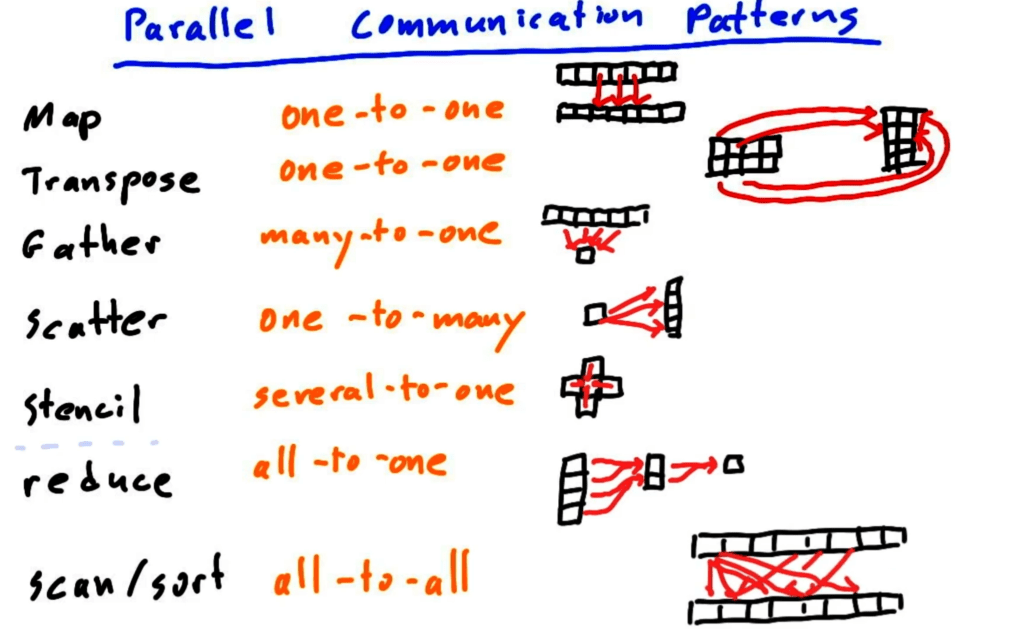
it’s from parallel programing from udacity.
 Naixian Zhang