Two years after the launch of ChatGPT, which completely revolutionized the way people work and reshaped the competitive AI landscape, large corporations in the United States are still struggling to systematically enable AI to learn from their proprietary databases and offer more effective services to their clients. Meanwhile, these companies continue to guard their core databases as private and valuable assets, refusing to share them.
It is often the leading AI companies and startups that drive innovation to solve such challenges. The Jupyter AI extension is one such example, offering a broad solution to all Jupyter notebook users.
in their docs, Jupyter AI claims that it offers:
Support for a wide range of generative model providers and models (AI21, Anthropic, Cohere, Gemini, Hugging Face, MistralAI, OpenAI, SageMaker, NVIDIA, etc.).
An %%ai magic that turns the Jupyter notebook into a reproducible generative AI playground. This works anywhere the IPython kernel runs (JupyterLab, Jupyter Notebook, Google Colab, VSCode, etc.).
A native chat UI in JupyterLab that enables you to work with generative AI as a conversational assistant.
for example,

in testing another example, i notice it actually references the proprietary codebase first
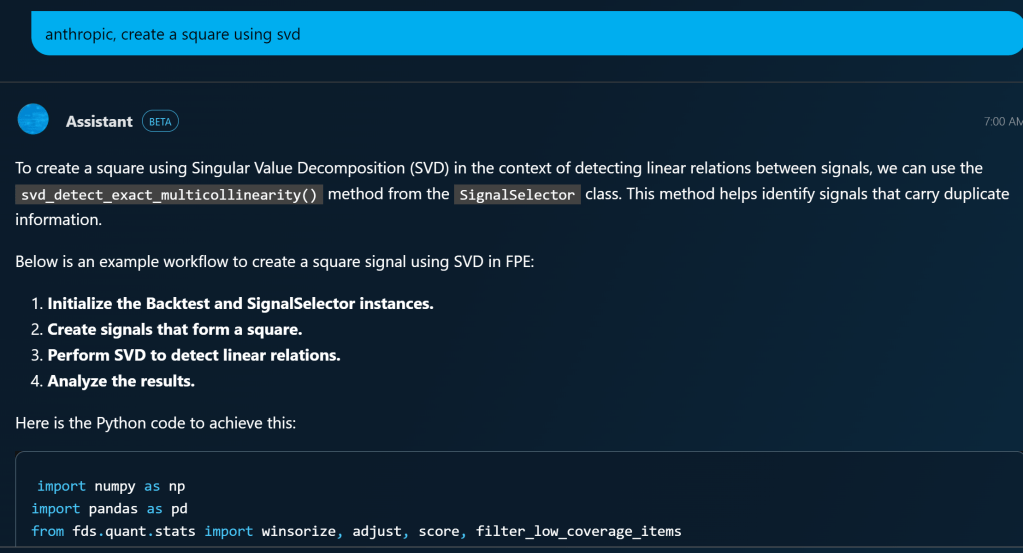
This tool embedded in FPE now solve the generic firm-wide problem of writing proprietary formulas for you. Even in the disclaimer, it emphasize /learn doesn’t actually learn your personal directory, but the company did apply AI to train or finetune its large codebase to solve a big pain point in the firm, which given the most remarkable achievement AI made in programing area, is a fair easy task!
But as of now, according to what I tested, the training is not perfect, even close to perfect yet. AI makes quite a lot of mistakes and make things up.
Next I am curious how this AI extension itself is developed, i.e. the original codes:.
 Naixian Zhang