in the github page, the three repos are pinnned:
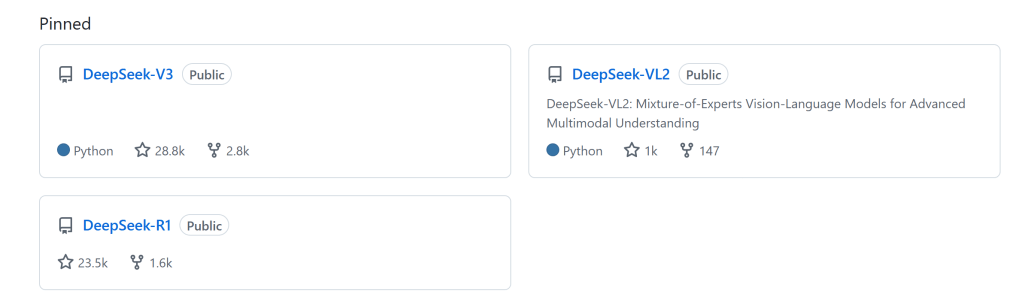
DeepSeek-VL2, an advanced series of large Mixture-of-Experts (MoE) Vision-Language Models that significantly improves upon its predecessor, DeepSeek-VL. DeepSeek-VL2 demonstrates superior capabilities across various tasks, including but not limited to visual question answering, optical character recognition, document/table/chart understanding, and visual grounding. Our model series is composed of three variants: DeepSeek-VL2-Tiny, DeepSeek-VL2-Small and DeepSeek-VL2, with 1.0B, 2.8B and 4.5B activated parameters respectively. DeepSeek-VL2 achieves competitive or state-of-the-art performance with similar or fewer activated parameters compared to existing open-source dense and MoE-based models.
DeepSeek-V3, a strong Mixture-of-Experts (MoE) language model with 671B total parameters with 37B activated for each token. To achieve efficient inference and cost-effective training, DeepSeek-V3 adopts Multi-head Latent Attention (MLA) and DeepSeekMoE architectures, which were thoroughly validated in DeepSeek-V2. Furthermore, DeepSeek-V3 pioneers an auxiliary-loss-free strategy for load balancing and sets a multi-token prediction training objective for stronger performance. We pre-train DeepSeek-V3 on 14.8 trillion diverse and high-quality tokens, followed by Supervised Fine-Tuning and Reinforcement Learning stages to fully harness its capabilities. Comprehensive evaluations reveal that DeepSeek-V3 outperforms other open-source models and achieves performance comparable to leading closed-source models. Despite its excellent performance, DeepSeek-V3 requires only 2.788M H800 GPU hours for its full training. In addition, its training process is remarkably stable. Throughout the entire training process, we did not experience any irrecoverable loss spikes or perform any rollbacks.
DeepSeek-R1-Zero and DeepSeek-R1, the first generation reasoning models launched by deepseek lately. DeepSeek-R1-Zero, a model trained via large-scale reinforcement learning (RL) without supervised fine-tuning (SFT) as a preliminary step, demonstrated remarkable performance on reasoning. With RL, DeepSeek-R1-Zero naturally emerged with numerous powerful and interesting reasoning behaviors. However, DeepSeek-R1-Zero encounters challenges such as endless repetition, poor readability, and language mixing. To address these issues and further enhance reasoning performance, we introduce DeepSeek-R1, which incorporates cold-start data before RL. DeepSeek-R1 achieves performance comparable to OpenAI-o1 across math, code, and reasoning tasks. To support the research community, we have open-sourced DeepSeek-R1-Zero, DeepSeek-R1, and six dense models distilled from DeepSeek-R1 based on Llama and Qwen. DeepSeek-R1-Distill-Qwen-32B outperforms OpenAI-o1-mini across various benchmarks, achieving new state-of-the-art results for dense models.
It does mentioned some techniques such as compressing key-value pairs to latent vector and introduce cold-data to avoid poor readability and language mixing in the reasoning model.
What are Qwen and LLaMA Models?
- Qwen: A large language model developed by a specific organization alibaba
- LLaMA (Large Language Model Meta AI): A family of foundational language models developed by Meta (formerly Facebook). LLaMA models are designed to be efficient and performant, even at smaller scales compared to models like GPT-3.Distilled models can exceed the performance of the original model in specific scenarios, such as when regularization, knowledge transfer, or task-specific fine-tuning is applied. However, this is not the norm, and distilled models are typically designed to be smaller and more efficient while maintaining comparable performance.
 Naixian Zhang