DeepSeek originated as a research initiative within High-Flyer, a Chinese quantitative hedge fund known for its AI-driven trading strategies. In April 2023, High-Flyer established DeepSeek as an independent entity dedicated to advancing artificial general intelligence (AGI), explicitly separating its research from the firm’s financial operations. Wikipedia
Since its inception, DeepSeek has developed several notable AI models. In May 2024, the company released DeepSeek-V2, which gained attention for its strong performance and cost-effectiveness, prompting competitive responses from major tech companies in China. Wikipedia
More recently, in January 2025, DeepSeek introduced the R1 model, capable of self-improvement without human supervision, further establishing its position in the AI research community.
The key innovations by deepseek? DeepSeek V3 R1 likely innovates by integrating:

- Weighted relevance scoring
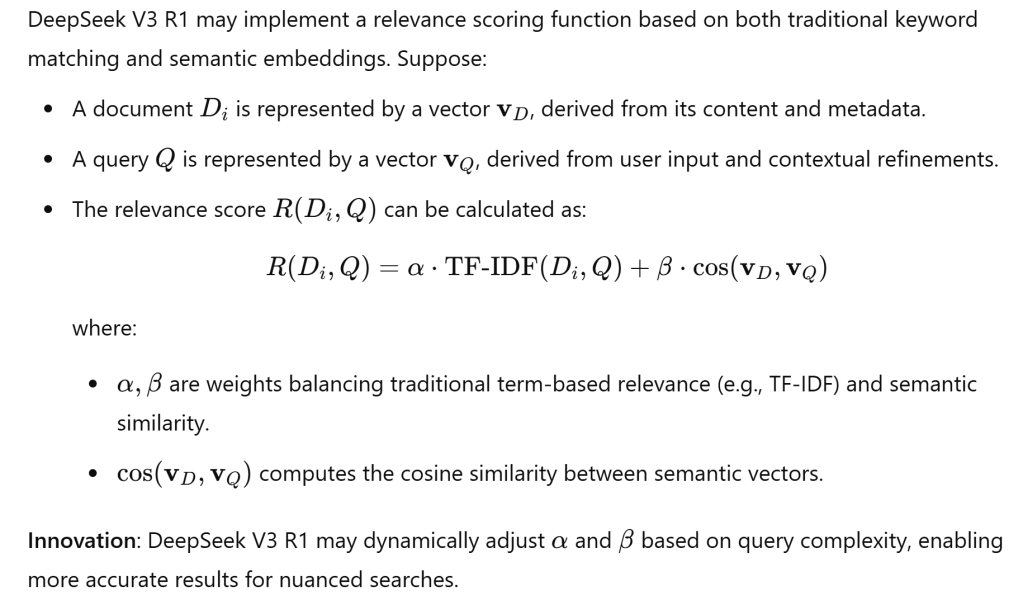
2. Contextual Query refinement
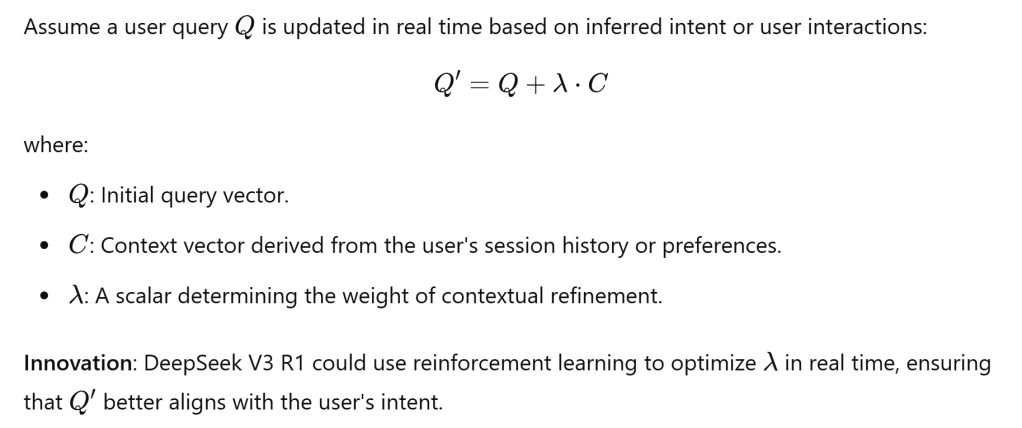
3. Hierarchical Search Space Optimization
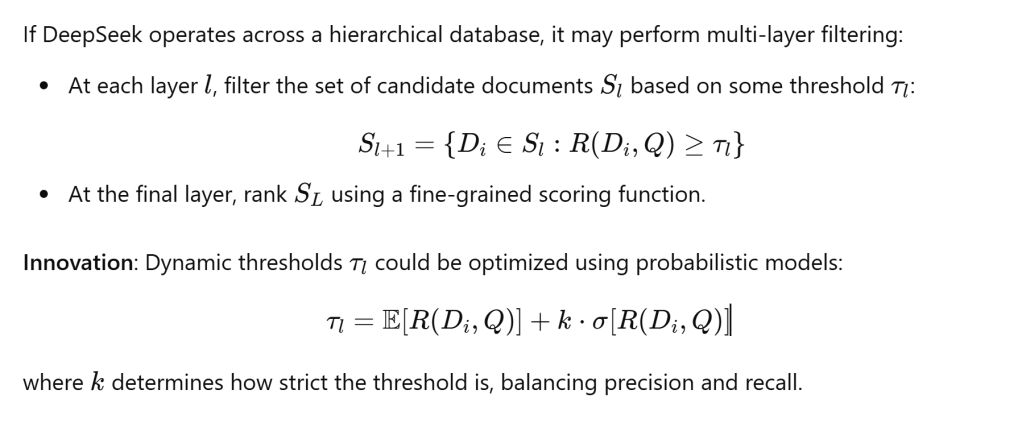
4. Attention driven ranking
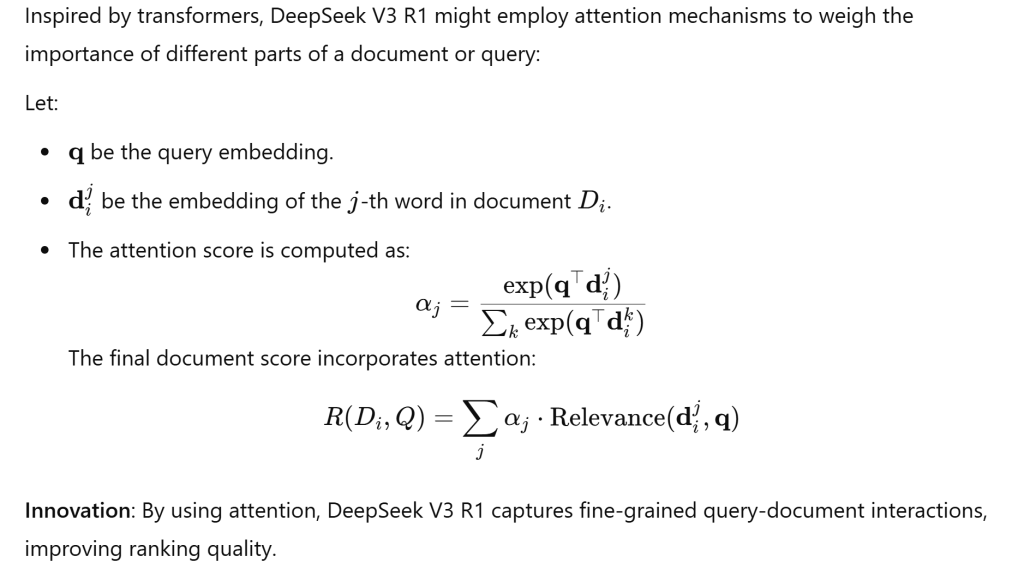
Another version from Claude 3.5 Sonnet: Searched web: deepseek r1 github code implementation reinforcement learning distillation
- GitHub – deepseek-ai/DeepSeek-R1
- DeepSeek-R1 — Training Language Models to reason through Reinforcement …
- Aakash Nain – DeepSeek-R1
- unsloth/DeepSeek-R1-Distill-Llama-8B-GGUF – Hugging Face
- DeepSeek-R1: Incentivizing Reasoning Capability in LLMs via DeepSeek-R1 …
MoE Architecture Implementation
# Pseudo-code representation of MoE layer
class MoELayer:
    def __init__(self, num_experts=16, hidden_size=4096):
        self.experts = [Expert() for _ in range(num_experts)]
        self.router = Router(hidden_size, num_experts)

    def forward(self, x):
        # Router selects top-k experts for each token
        expert_weights = self.router(x)  # Shape: [batch_size, seq_len, num_experts]
        top_k_weights, top_k_indices = select_top_k(expert_weights, k=2)

        # Only activate selected experts
        output = sum([
            weight * self.experts[idx](x)
            for weight, idx in zip(top_k_weights, top_k_indices)
        ])
        return output
Reinforcement Learning Training
# Group Relative Policy Optimization implementation
def grpo_training_step(model, batch, optimizer):
    # Generate multiple responses for each prompt
    responses = []
    for _ in range(group_size):
        response = model.generate(
            batch['prompt'],
            max_length=32768,  # Extended context window
            temperature=0.6,
            top_p=0.95
        )
        responses.append(response)

    # Compute rewards for each response
    rewards = [
        compute_reward(response, batch['ground_truth'])
        for response in responses
    ]

    # Update policy using GRPO
    loss = compute_grpo_loss(responses, rewards)
    loss.backward()
    optimizer.step()
Reward Function Implementation
def compute_reward(response, ground_truth):
    # Accuracy component
    accuracy_reward = evaluate_correctness(response, ground_truth)

    # Format adherence component
    format_reward = check_formatting(response)

    # Language consistency component (addressing mixing issues)
    language_consistency = calculate_language_consistency(response)

    return (
        accuracy_reward +
        format_reward * format_weight +
        language_consistency * consistency_weight
    )
Training Pipeline Structure
class DeepSeekTrainingPipeline:
    def train(self, base_model):
        # Phase 1: Direct RL (DeepSeek-R1-Zero)
        model_zero = self.train_with_rl(base_model)

        # Phase 2: Cold Start Data
        sft_data = load_reasoning_examples()
        model_sft = self.supervised_fine_tune(base_model, sft_data)

        # Phase 3: Advanced RL
        model_r1 = self.train_with_rl(model_sft)

        # Phase 4: Distillation
        distilled_models = self.distill_to_sizes([
            "1.5B", "7B", "8B", "14B", "32B", "70B"
        ], model_r1)
Distillation Process
def distill_knowledge(teacher_model, student_model):
def training_step(batch):
# Teacher generates reasoning paths
with torch.no_grad():
teacher_outputs = teacher_model(
batch['input'],
temperature=0.6,
max_length=32768
)
    # Student learns from teacher's outputs
    student_outputs = student_model(batch['input'])

    # Knowledge distillation loss
    kd_loss = compute_distillation_loss(
        student_outputs,
        teacher_outputs,
        temperature=2.0  # Higher temperature for softer probabilities
    )
    return kd_loss
Evaluation Setup
def evaluate_model(model, benchmark_data):
    results = {}

    # Configure generation parameters
    gen_kwargs = {
        "max_length": 32768,
        "temperature": 0.6,
        "top_p": 0.95,
        "num_return_sequences": 64  # For pass@1 calculation
    }

    for benchmark, data in benchmark_data.items():
        correct = 0
        for sample in data:
            responses = model.generate(sample['input'], **gen_kwargs)
            # Take best of 64 responses
            correct += any(is_correct(r, sample['answer']) for r in responses)

        results[benchmark] = correct / len(data)

    return results
Overall, what generated by openAI or Claude 3.5 sonnet is lack of satisfaction. in the next blog, I will dive deep to the github codes and paper of deepseek and use deepseek itself to analyze it.
 Naixian Zhang