The determinant is a single number associated with a square matrix that tells you how the matrix transforms space. Intuitively, you can think of it as a scaling factor for volume and a test for invertibility.
- Volume Interpretation:
- Imagine a 2×2 matrix as a transformation applied to a unit square. The determinant tells you how the area of the transformed shape changes:
- det>0\det > 0det>0 → The area is preserved (possibly stretched or shrunk, but orientation is the same).
- det<0\det < 0det<0 → The area is preserved but flipped (like a reflection).
- det=0\det = 0det=0 → The area collapses to a line (losing a dimension).
- In 3D, the determinant tells you how a cube’s volume is changed.
- Imagine a 2×2 matrix as a transformation applied to a unit square. The determinant tells you how the area of the transformed shape changes:
- Invertibility:
- If detA=0\det A = 0detA=0, the transformation squashes space in a way that information is lost, making it non-invertible.
- If detA≠0\det A \neq 0detA=0, the transformation preserves some structure and is invertible.
- Direction and Orientation:
- A positive determinant means the transformation preserves the original “handedness” of space.
- A negative determinant means the transformation flips it, like switching from a right-handed to a left-handed coordinate system.
Exterior algebra is a mathematical structure that extends linear algebra to handle oriented areas, volumes, and higher-dimensional objects using a formal system of “wedge products.” It is fundamental in differential geometry, gauge theory, and physics.
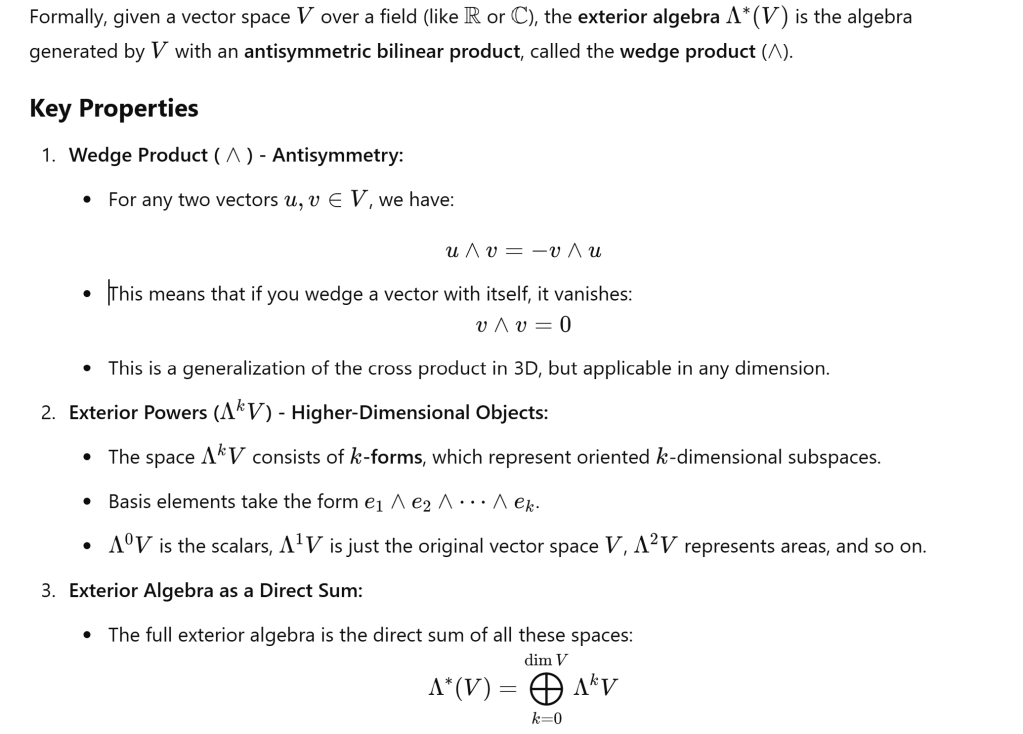
Why Is Exterior Algebra Important?
- Generalizes Determinants and Cross Products
- The determinant can be understood through wedge products.
- The cross product in 3D is a special case of the wedge product in Λ2V\Lambda^2 VΛ2V.
- Useful in Gauge Theory and Physics
- Gauge fields (like the electromagnetic field tensor) are expressed as differential forms.
- The exterior derivative and wedge product elegantly describe field strength tensors.
- Describes Volume and Orientation
- In higher dimensions, it allows a natural way to compute areas, volumes, and their generalizations.
In Exterior Algebra, see how determinant is generated:
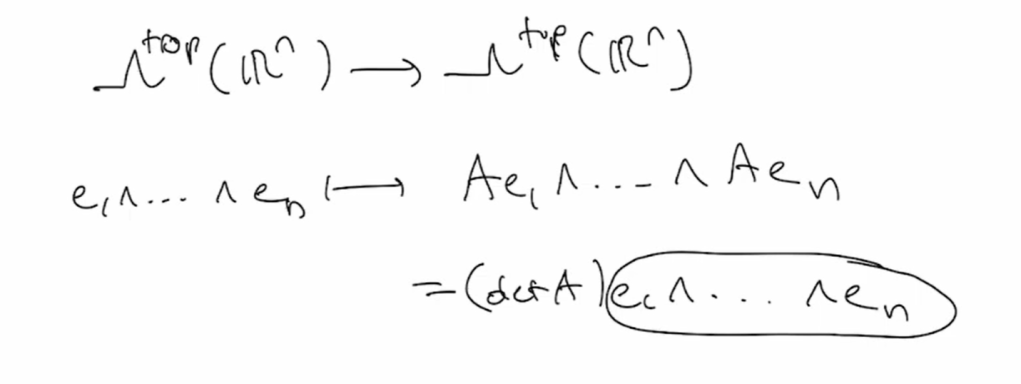
According to the original understanding of determinant as the “increased/decreased” area after the matrix transformation, it does make a lot of sense it’s function in this exterior algebra.
 Naixian Zhang