Manus become a big hype, and in a few day, anus posted open-source codes replicating manus, so let me dive into manus codes to see how to build a multi0agent cool app leveraging AI!
The Anus AI agent architecture combines the best aspects of OpenManus and OWL while introducing unique features that address limitations in both systems. By focusing on accessibility, flexibility, and community involvement, Anus aims to become a leading open-source AI agent framework that can be used for a wide range of applications, from simple task automation to complex multi-agent collaborations.
there in core folder there are agent folder with base agent, hybrid-agent, react agent and tool_agent,
    self.specialized_agents = {
        "researcher": ToolAgent(name="researcher", tools=tools),
        "planner": ToolAgent(name="planner", tools=tools),
        "executor": ToolAgent(name="executor", tools=tools),
        "critic": ToolAgent(name="critic", tools=tools)
There are memory folder, planning folder and orhestrator.py. According to the readme.md in this core folder, there are various components:
orchestrator.py
Manages the lifecycle of agents, handles agent creation, destruction, and resource allocation.
planner.py
Breaks down complex tasks into manageable steps, assigns steps to appropriate agents or tools.
memory.py
Maintains short-term and long-term memory, manages conversation history and context.
tool_manager.py
Provides a standardized API for tool integration, tool discovery and registration system.
config.py
Configuration management for the core module.
utils.py
Utility functions used across the core module.
Anus Models Module
This module contains the model integration components of the Anus AI framework, including:
- OpenAI API Support
- Open-Source Model Support
- Model Switching and Fallback Mechanisms
- Vision Model Integration
Anus Tools Module
This module contains the tool ecosystem components of the Anus AI framework, including:
- Web Interaction Tools (Browser Automation)
- Information Retrieval Tools (Search, Wikipedia)
- Document Processing Tools (PDF, Word, Excel)
- Code Execution Environment
- Multimodal Processing (Images, Audio, Video)
Components
base_tool.py
Base class for all tools with common functionality and interface.
web_tools.py
Browser automation using Playwright, web scraping, and data extraction.
search_tools.py
Search engine integration, Wikipedia access, and information retrieval.
document_tools.py
PDF parsing, Office document handling, and data extraction.
code_tools.py
Secure Python execution sandbox and code analysis.
multimodal_tools.py
Image, audio, and video processing capabilities.
registry.py
Tool registration and discovery system.
main py
"""
Anus - Autonomous Networked Utility System
Main entry point for the Anus AI agent framework
"""

import argparse
import sys
from anus.core.orchestrator import AgentOrchestrator
from anus.ui.cli import CLI

def main():
    """Main entry point for the Anus AI agent"""
    parser = argparse.ArgumentParser(description="Anus AI - Autonomous Networked Utility System")
    parser.add_argument("--config", type=str, default="config.yaml", help="Path to configuration file")
    parser.add_argument("--mode", type=str, default="single", choices=["single", "multi"], help="Agent mode")
    parser.add_argument("--task", type=str, help="Task description")
    parser.add_argument("--verbose", action="store_true", help="Enable verbose output")

    args = parser.parse_args()

    # Initialize the CLI
    cli = CLI(verbose=args.verbose)

    # Display welcome message
    cli.display_welcome()

    # Initialize the agent orchestrator
    orchestrator = AgentOrchestrator(config_path=args.config)

    # If task is provided as argument, execute it
    if args.task:
        result = orchestrator.execute_task(args.task, mode=args.mode)
        cli.display_result(result)
        return

    # Otherwise, start interactive mode
    cli.start_interactive_mode(orchestrator)

if __name__ == "__main__":
    main()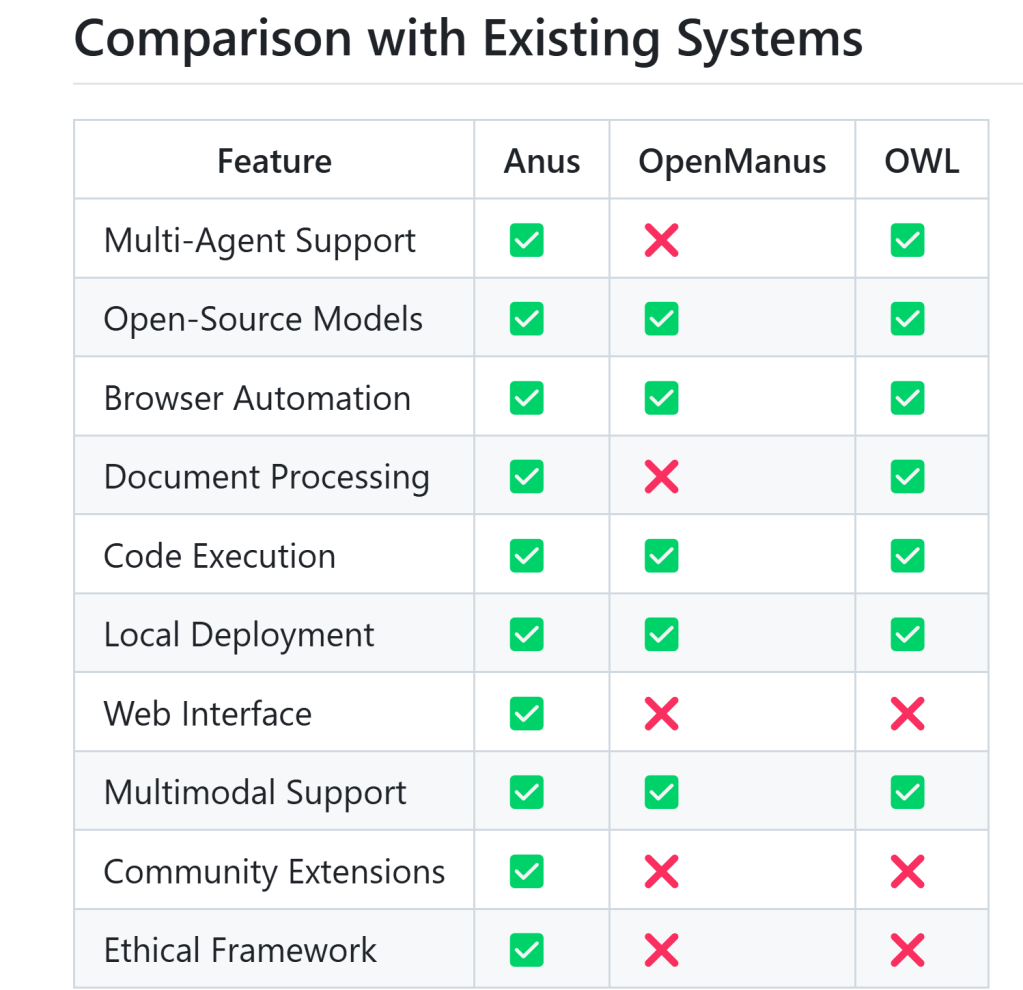
Valuable Concepts from OpenManus for ANUS Implementation
1. Agent Architecture
Core Concept: Layered Agent Abstraction
OpenManus implements a well-structured agent hierarchy with clear separation of concerns:
BaseAgent: Abstract foundation with core functionalityReActAgent: Extends base with reasoning capabilitiesToolCallAgent: Adds tool execution capabilitiesManus: Concrete implementation with specific tools
This layered approach allows for:
- Clear inheritance patterns
- Progressive enhancement of capabilities
- Separation of core logic from specific implementations
Adaptation for ANUS:
ANUS can adopt this pattern while enhancing it with its planned “Hybrid Agent System” that switches between single and multi-agent modes. The base architecture could be extended to support dynamic role assignment and agent collaboration.
2. Planning System
Core Concept: Structured Planning with Step Management
OpenManus implements a sophisticated planning system through:
PlanningFlow: Manages execution of multi-step plansPlanningTool: Creates and tracks plan progress- Step status tracking (not_started, in_progress, completed)
- Dynamic step execution with appropriate agent selection
This planning system enables:
- Breaking complex tasks into manageable steps
- Tracking progress through plan execution
- Selecting appropriate agents for specific step types
Adaptation for ANUS:
ANUS can enhance this planning system to support its “Dynamic Task Planning” feature, adding capabilities for resource allocation and parallel execution of steps when appropriate.
3. Tool Integration Framework
Core Concept: Flexible Tool System
OpenManus implements a robust tool framework through:
BaseTool: Abstract foundation for all toolsToolCollection: Container for managing multiple tools- Standardized execution interface
- Tool result handling with success/failure patterns
This tool system enables:
- Easy addition of new capabilities
- Consistent interface for tool execution
- Proper error handling and result processing
Adaptation for ANUS:
ANUS can adopt this pattern while expanding it to support its “Comprehensive Tool Ecosystem” with categorized tools for web interaction, information retrieval, document processing, etc.
4. Flow Management
Core Concept: Execution Flow Abstraction
OpenManus separates execution flow from agent logic through:
BaseFlow: Abstract foundation for execution patternsPlanningFlow: Concrete implementation for planning-based executionFlowFactory: Factory pattern for creating appropriate flows
This flow abstraction enables:
- Different execution strategies without changing agent code
- Clear separation between agent capabilities and execution patterns
- Factory pattern for easy creation of appropriate flows
Adaptation for ANUS:
ANUS can leverage this pattern to implement its “Multi-Agent Collaboration” feature, creating specialized flows for different collaboration patterns and consensus mechanisms.
5. Browser Integration
Core Concept: Comprehensive Browser Automation
OpenManus implements browser automation through:
BrowserUseTool: Wrapper for browser automation capabilities- Support for navigation, interaction, content extraction
- Structured interface for browser operations
This browser integration enables:
- Web-based information gathering
- Form filling and submission
- Content extraction and analysis
Adaptation for ANUS:
ANUS can adopt this pattern while enhancing it with its planned “Web Interaction” capabilities, including authentication handling and more sophisticated scraping.
6. LLM Abstraction
Core Concept: Model Interaction Abstraction
OpenManus abstracts LLM interactions through:
- Standardized interface for model communication
- Support for tool/function calling
- Consistent message formatting
This LLM abstraction enables:
- Swapping underlying models without changing agent code
- Standardized handling of model responses
- Consistent tool calling interface
Adaptation for ANUS:
ANUS can enhance this pattern to support its “Flexible Model Integration” feature, adding support for open-source models and local deployment options.
7. Memory Management
Core Concept: Agent Memory System
OpenManus implements a basic memory system for agents:
- Message history tracking
- Context management for conversations
- State persistence between interactions
Adaptation for ANUS:
ANUS can significantly enhance this concept to implement its planned “Memory Management” with short-term and long-term memory systems for better context retention.
8. Modular Configuration
Core Concept: Configuration Management
OpenManus implements configuration handling through:
- External configuration files (TOML)
- Structured configuration objects
- Default values with override capabilities
This configuration system enables:
- Easy customization without code changes
- Environment-specific configurations
- Sensible defaults with override options
Adaptation for ANUS:
ANUS can adopt this pattern while enhancing it to support its more complex configuration needs for multi-agent setups and tool ecosystems.
 Naixian Zhang