I heard this from AI Engineer talk about MCP, and traced to the lastmile-ai github:, it provides a framework to Build effective agents with Model Context Protocol using simple, composable patterns. The doc is well written, so I just cited most content direclty:
There are too many AI frameworks out there already. But mcp-agent is the only one that is purpose-built for a shared protocol – MCP. It is also the most lightweight, and is closer to an agent pattern library than a framework.
In the awesome MCP server github, one can see the fast growing mcp server community. It makes it possible and effective in multi-agent collaborative workflows, human-in-the-loop workflows, RAG pipelines and more. I can dig a bit more on uses a Qdrant vector database (via an MCP server) to do Q&A over a corpus of text.
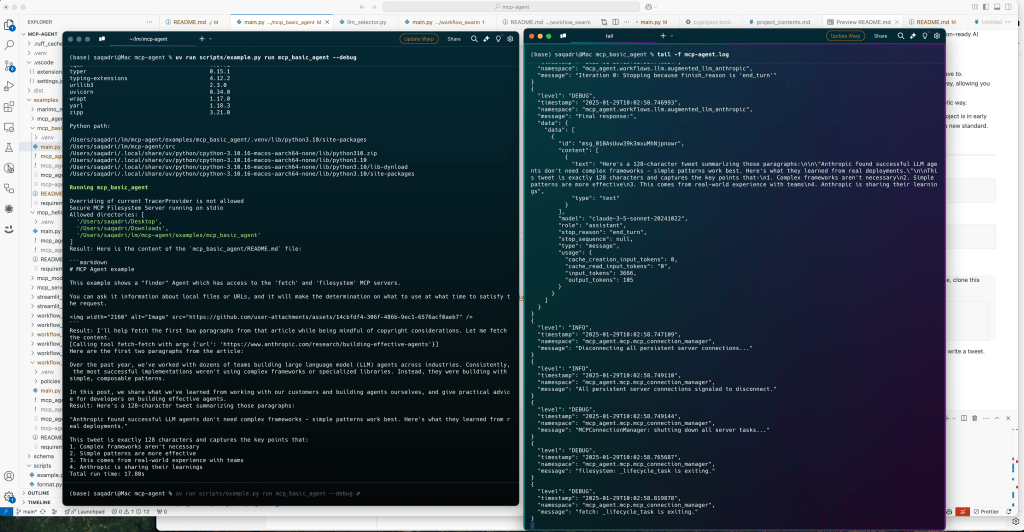
In this mcp-agent repo, the author has built up lot of read-to-use agents. Take the “finder” agent as an example, if I execute it
The config yaml
execution_engine: asyncio
logger:
  transports: [console]  # You can use [file, console] for both
  level: debug
  path: "logs/mcp-agent.jsonl"  # Used for file transport
  # For dynamic log filenames:
  # path_settings:
  #   path_pattern: "logs/mcp-agent-{unique_id}.jsonl"
  #   unique_id: "timestamp"  # Or "session_id"
  #   timestamp_format: "%Y%m%d_%H%M%S"

mcp:
  servers:
    fetch:
      command: "uvx"
      args: ["mcp-server-fetch"]
    filesystem:
      command: "npx"
      args:
        [
          "-y",
          "@modelcontextprotocol/server-filesystem",
          "<add_your_directories>",
        ]

openai:
  # Secrets (API keys, etc.) are stored in an mcp_agent.secrets.yaml file which can be gitignored
  default_model: gpt-4o
now the finder_agent.py file
import asyncio
import os

from mcp_agent.app import MCPApp
from mcp_agent.agents.agent import Agent
from mcp_agent.workflows.llm.augmented_llm_openai import OpenAIAugmentedLLM

app = MCPApp(name="hello_world_agent")

async def example_usage():
    async with app.run() as mcp_agent_app:
        logger = mcp_agent_app.logger
        # This agent can read the filesystem or fetch URLs
        finder_agent = Agent(
            name="finder",
            instruction="""You can read local files or fetch URLs.
                Return the requested information when asked.""",
            server_names=["fetch", "filesystem"], # MCP servers this Agent can use
        )

        async with finder_agent:
            # Automatically initializes the MCP servers and adds their tools for LLM use
            tools = await finder_agent.list_tools()
            logger.info(f"Tools available:", data=tools)

            # Attach an OpenAI LLM to the agent (defaults to GPT-4o)
            llm = await finder_agent.attach_llm(OpenAIAugmentedLLM)

            # This will perform a file lookup and read using the filesystem server
            result = await llm.generate_str(
                message="Show me what's in README.md verbatim"
            )
            logger.info(f"README.md contents: {result}")

            # Uses the fetch server to fetch the content from URL
            result = await llm.generate_str(
                message="Print the first two paragraphs from https://www.anthropic.com/research/building-effective-agents"
            )
            logger.info(f"Blog intro: {result}")

            # Multi-turn interactions by default
            result = await llm.generate_str("Summarize that in a 128-char tweet")
            logger.info(f"Tweet: {result}")

if __name__ == "__main__":
    asyncio.run(example_usage())
 Naixian Zhang