MVC is an architectural pattern (a reusable solution to a common problem) that tackles a hodge-podge styled codebase by dividing the application into three distinct, interconnected components:
- Model (M): The Data and Business Logic
- View (V): The User Interface
- Controller (C): The Orchestrator/Handler
1. Model (M): The Data & Brains
- What it is: Represents the application’s data and the rules that govern it (business logic). It’s the “truth” of your application state.
- What it does:
- Manages data (fetching from database, saving to database, interacting with APIs).
- Enforces data consistency and validation rules (e.g., “email must be valid,” “price cannot be negative”).
- Performs calculations or operations directly related to the data.
- Crucially: It knows nothing about how the data will be displayed (no HTML, no GUI widgets here). It just holds and manages the raw information and logic.s
- Python Context:
- Classes representing your core concepts (e.g., User, Product, Order).
- Database interaction code (using ORMs like SQLAlchemy or Django ORM, or direct DB-API calls).
- Functions or methods for validation and calculations.
- Often plain Python classes and functions.
2. View (V): What the User Sees
- What it is: Responsible for presenting the data (from the Model) to the user and sending user commands/input to the Controller. It’s the User Interface (UI).
- What it does:
- Displays data it receives (usually passed from the Controller).
- Formats the data for presentation (HTML, GUI layout, JSON structure).
- Captures user interactions (button clicks, form submissions, key presses).
- Crucially: It generally doesn’t contain much logic. It’s often considered “dumb” – its main job is presentation and capturing input. It doesn’t modify data directly.
- Python Context:
- HTML Templates (Jinja2, Django Templates).
- GUI Widgets (Tkinter buttons/labels, PyQt elements).
- Functions that generate JSON/XML responses for APIs.
- Functions that print formatted output to the console.
3. Controller (C): The Handler/Orchestrator
- What it is: Acts as the intermediary between the Model and the View. It handles user input and updates the Model or View as necessary.
- What it does:
- Receives user input/requests (from the View or the framework’s routing).
- Interprets the input (e.g., “user wants to see profile,” “user submitted new data”).
- Interacts with the Model (e.g., model.get_user(id), model.save_new_user(data)).
- Selects the appropriate View to display.
- Passes data from the Model to the View for rendering.
- Python Context:
- Flask route handler functions (@app.route(‘/users’) def show_users(): …).
- Django “views” (confusingly named, they act as Controllers in MVC).
- Event handler functions in GUI applications (e.g., on_button_click()).
- Functions that process command-line arguments.
- Flask: Less opinionated, doesn’t enforce MVC strictly, but naturally encourages it.
- Model: You typically bring your own (like SQLAlchemy) or write custom data-handling code.
- View: Usually Jinja2 templates.
- Controller: Route handler functions (@app.route(…)).
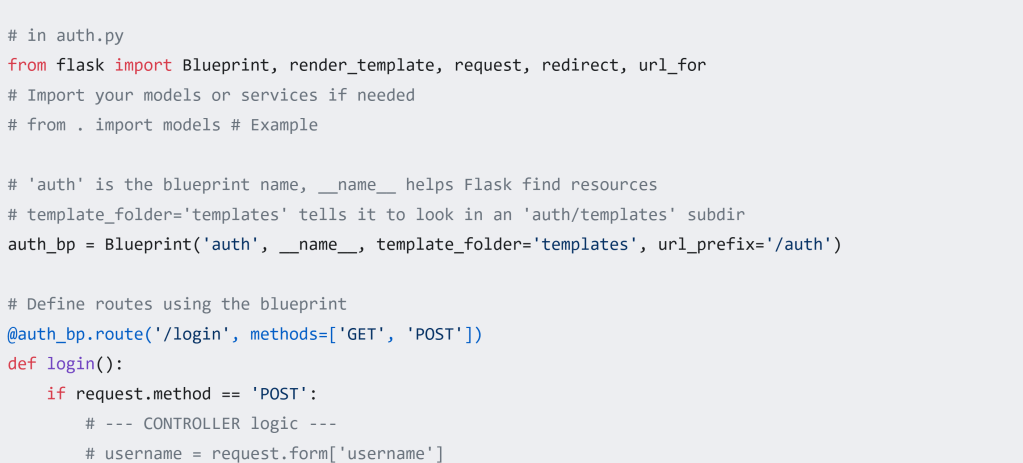
Blueprints as the Solution: Modularization:
 Naixian Zhang