Physics asks: how does something change as you move? Geometry asks: what does “moving” even mean if space has structure? Gauge theory answers both by saying: Forces arise because “comparison across space” is not trivial.
Concept
Physical Meaning
Geometric Meaning
Gauge Potential ($A_\mu$)
The Photon/Gluon field
The Connection (how to compare fibers)
Field Strength ($F_{\mu\nu}$)
The Electric/Magnetic Force
The Curvature (how much the bundle is twisted)
Gauge Transform
Changing your units locally
Rotating the fiber at a specific point
On top of spacetime where every point exists, there is fiber, we need to measure fiber when moving along spacetime.
There is no canonical way to align fibers at different points. Connection is the rule. Gauge potential Aμ is the connection, the rule for sliding from one fiber to the next
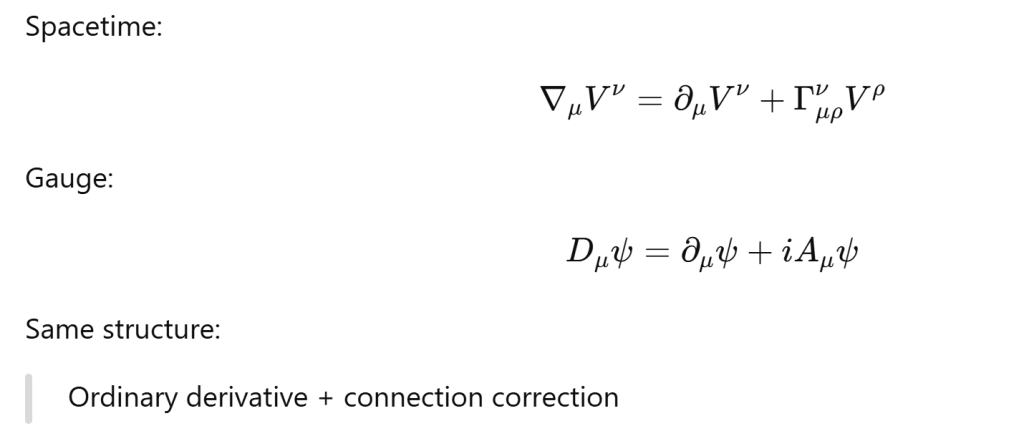
Aμ appears inside the covariant derivative which is to measure when the underlying unit and direction is also changing.
Field strength measures: How much parallel transport depends on the path. Fμν = curvature Exactly like Riemann curvature in GR.
if space (or the bundle) is curved: “Straight” paths bend relative to flat expectations.
Christoffel symbols and gauge potentials are the same geometric object: connections — acting on different bundles. Gravity bends spacetime. Gauge fields twist internal space.Christoffel symbols encode how spacetime itself tells vectors how to slide. Aμ encodes how internal space tells internal states how to slide.
So now we understand broadly that second-order –> curvature –> force, let’s expand and explore more:
Parallel transport is the operational manifestation of a connection. A connection is the rule; parallel transport is what you do with that rule.

 Naixian Zhang