We get it naturally that QRQ-1 is rotating R, but think deeper, isn’t QR already complete the rotation action?? Yes, it Q rotates R, but it does not rotate axis of R!
But QRQ-1 is not simple composition, it represents rotation of R in a different, rotated frame!
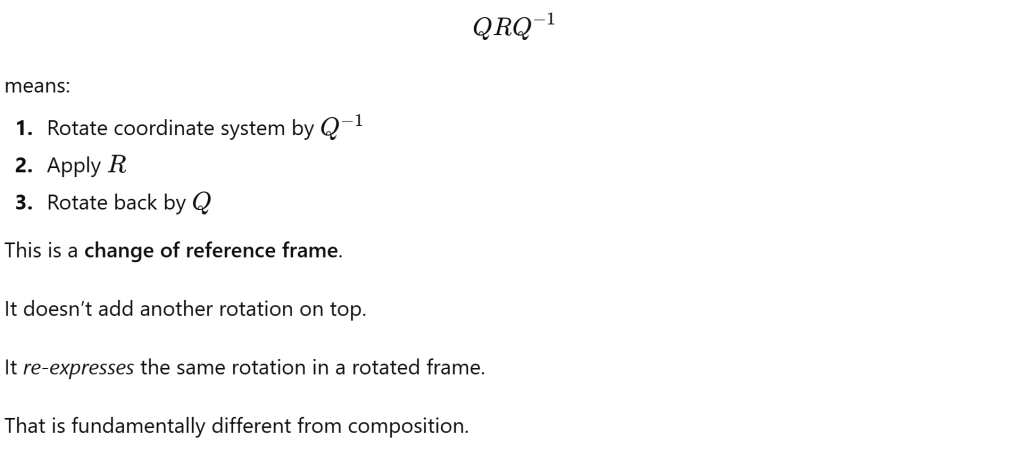
Another angle to understand QRQ-1 is let T=QRQ−1, it means:
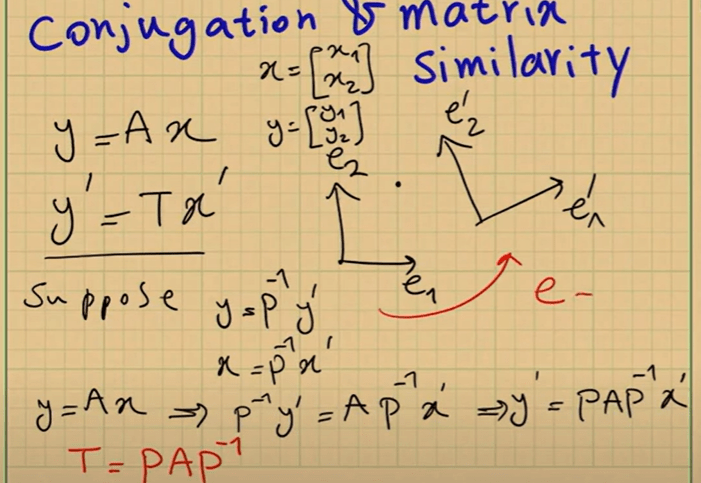
T is the same rotation as R, expressed in a rotated coordinate system. That is exactly matrix similarity.
And in Lie theory, this becomes the adjoint representation.
 Naixian Zhang