In last blog, we discussed the SU(2) representations:
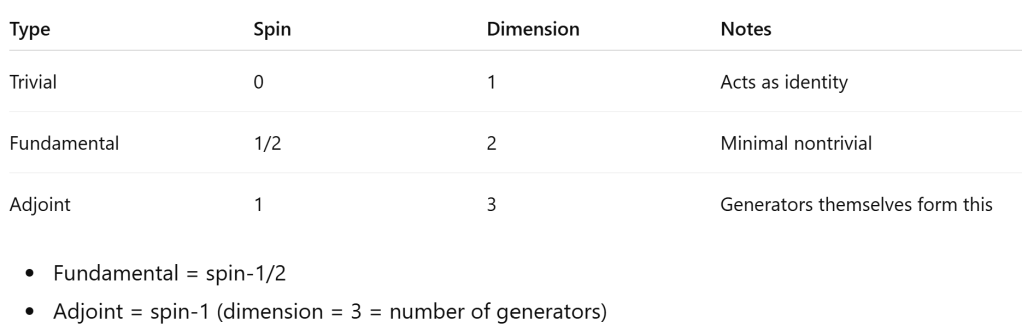
Complexified Lorentz: SU(2)_L ⊕ SU(2)_R, We saw:so(1,3)C≅su(2)L⊕su(2)R
So representations are tensor products:
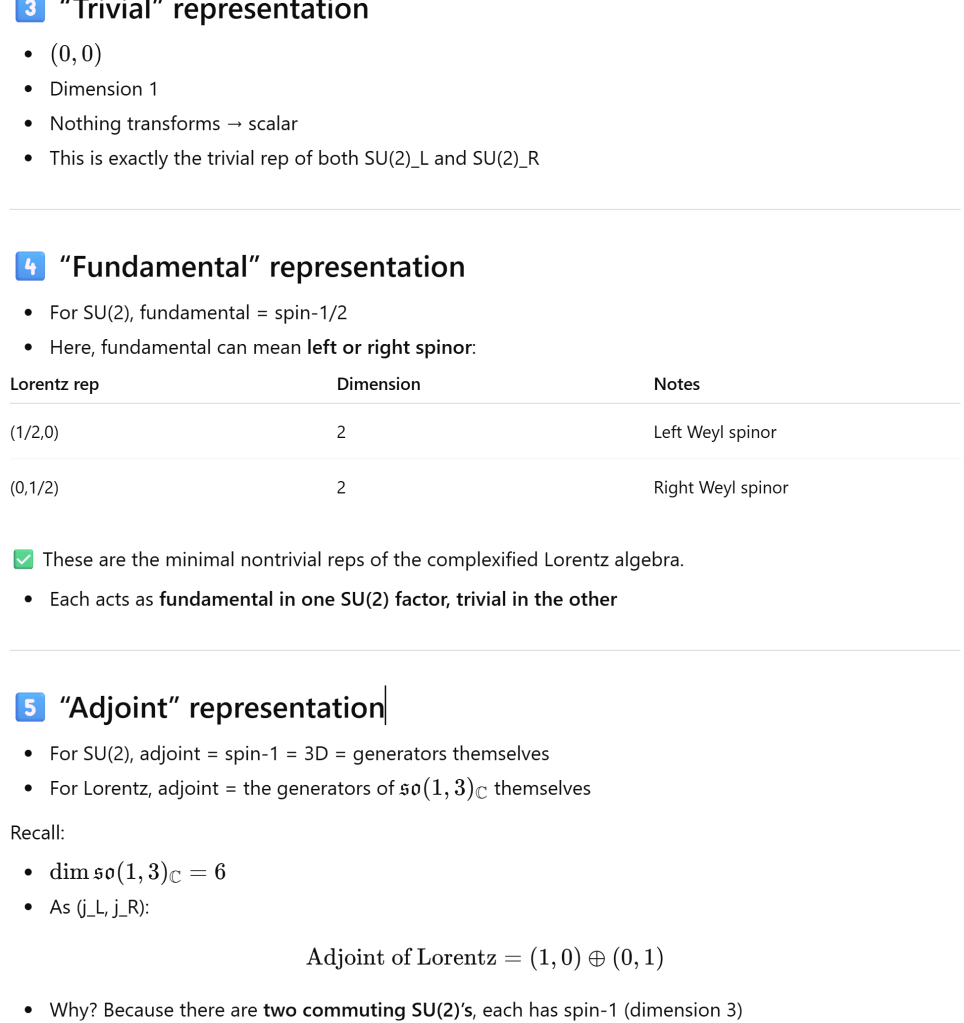
Now let’s build a structured and precise picture of Lorentz representations,
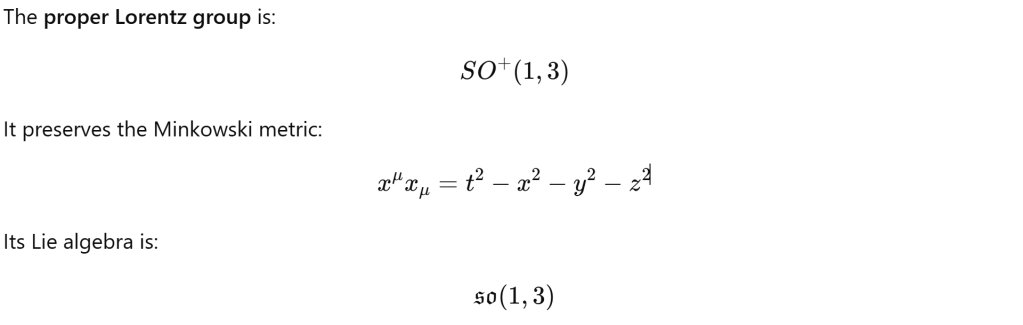
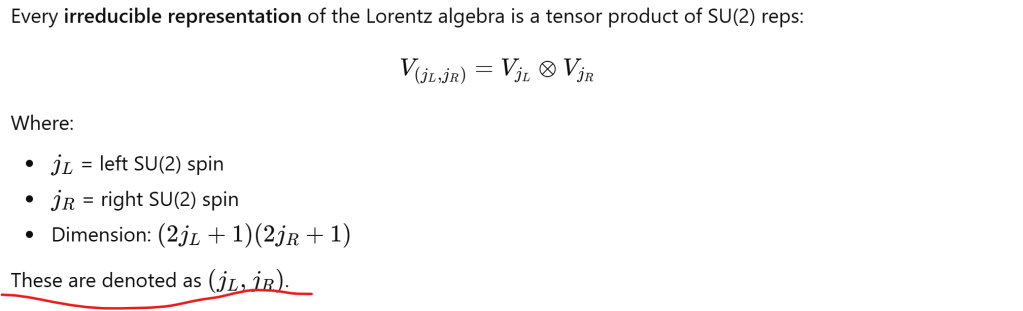
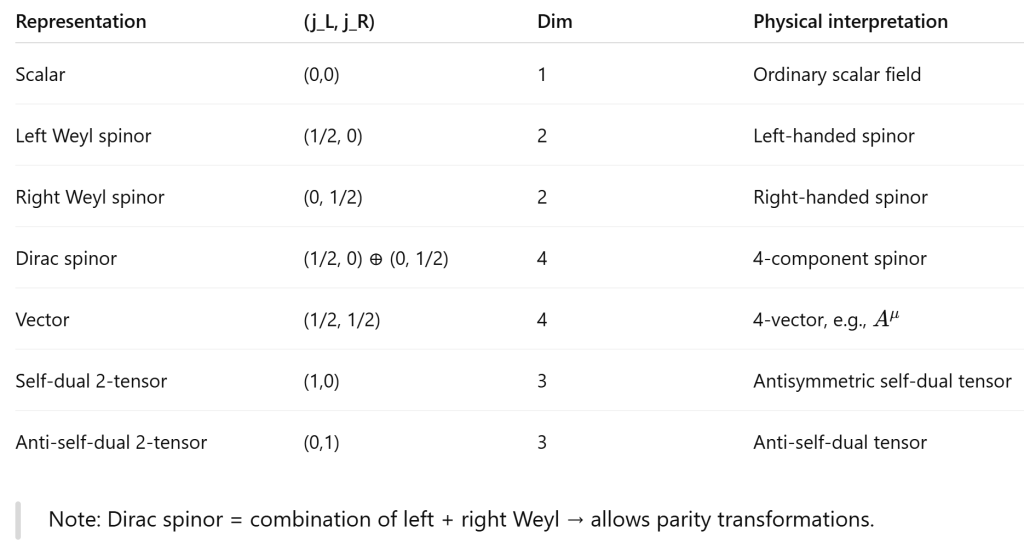
Math is the most beautiful and rigorous language, so we need to clarify when we say representation!
- A representation is a map from an algebra (or group) to linear operators on some vector space.
- The “vector space” itself (the space where the operators act) is sometimes loosely referred to as the representation, but strictly, the representation is the map + the space.
Example:
- SU(2) spin-1/2 representation = map from SU(2) generators → 2×2 Pauli matrices acting on C2
- The 2D space of spinors = “the representation space”
For the Lorentz group / algebra:
- Lorentz representation = any irreducible (or reducible) representation of so(1,3) (or the group SO+(1,3)), so any of these in above table can be called a Lorentz representation, because they all carry an action of the Lorentz group.
 Naixian Zhang