When Dirac solved the famous Dirac equation, he was troubled by the introduction of “negative energy” due to the bottom spinor. Later, when quantum field theory emerged, this problem was addressed: there is no negative energy in our universe. The interpretation introduced both the electron and the positron. Therefore, the key here is to understand the positron!
Here is the quant field equation:
And the relativistic equation gives two energy branches:
The leap jump in connecting these two is not to interpret or treat same particle in the equations, but
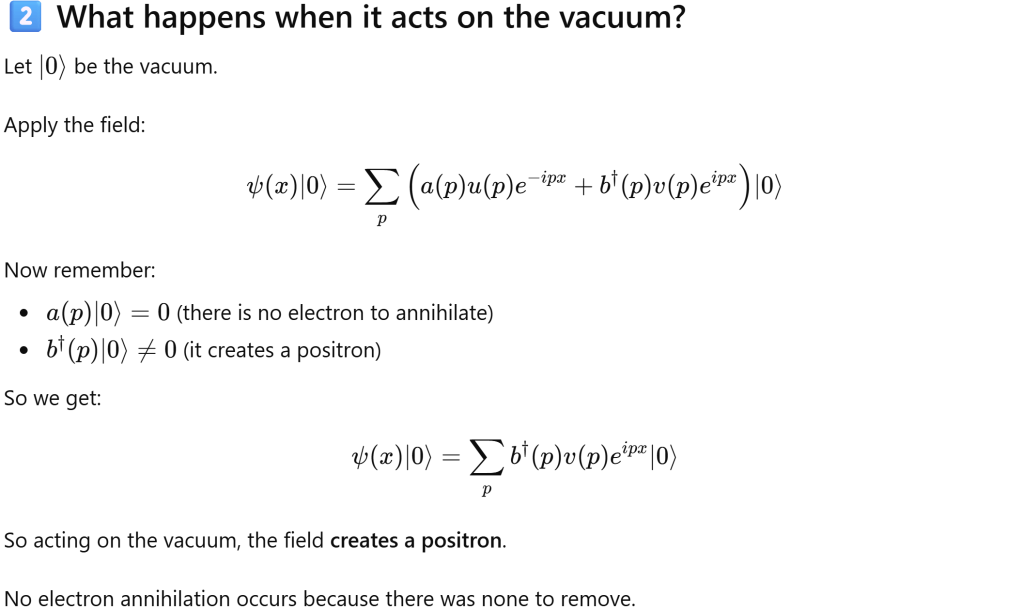
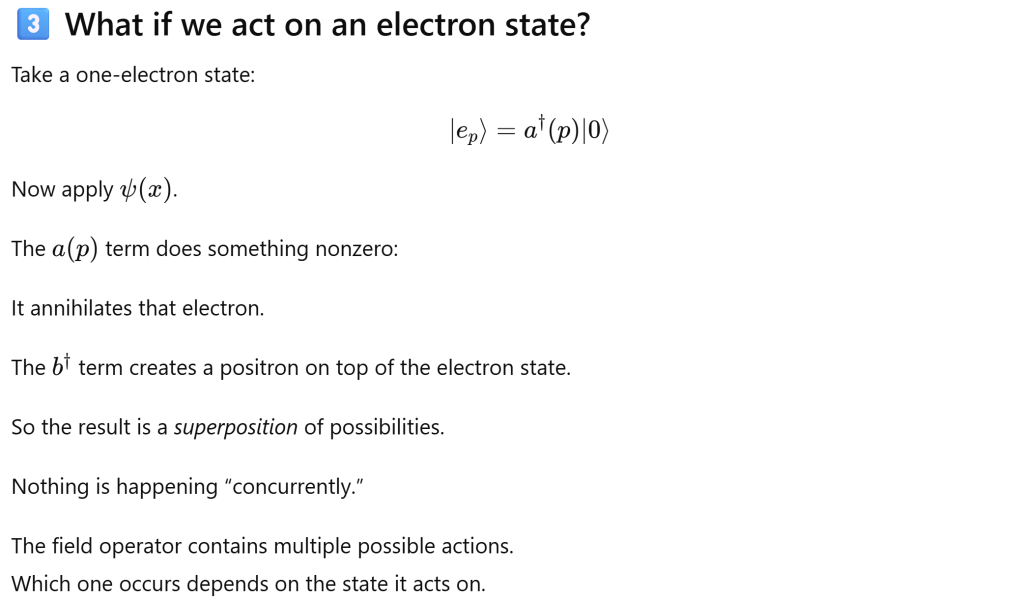
e−ipx with a(p) is interpreted as annihilating a particle with positive energy
e+ipx with a†(p) is interpreted as creating a particle with positive energy
In particular, when the field carries electric charge, then when you quantize it properly, you must write:b†(p) creates something different; a(p) annihilates an electron
The a-quanta carry charge −e; The b-quanta carry charge +e
To deeply understand, we first need to be crystal clear that ψ(x) is not describing something that is “happening.” It is an operator-valued field.
Then a natural question is why there are so many electrons, but rarely we detect positrons??
 Naixian Zhang