Fiber bundle: fiber bundle is a concept from topology and geometry, often used in fields such as physics and differential geometry. It consists of a space that locally resembles a product of two spaces but globally may have a more complicated structure. More formally, it is defined by the following components:
Local triviality condition: The key idea behind a fiber bundle is that, locally, the total space EEE looks like a product of the base space BBB and the fiber FFF. In other words, for each point in the base space, there is a neighborhood that looks like the product space B×FB \times FB×F.
Total space (EEE): This is the entire space of the bundle, which can be thought of as the “whole” of the fiber bundle.
Base space (BBB): This is the space over which the fiber bundle is defined. You can think of it as the “base” or the “base manifold” on which the fiber bundle is built.
Fiber (FFF): The fiber is a space that is associated with each point in the base space. It is the “fiber” that “sits” over each point of the base space.
Projection map (π:E→B\pi: E \to Bπ:E→B): This is a continuous map from the total space EEE to the base space BBB that projects each point in the total space down to the corresponding point in the base space. The projection map ensures that the structure of the fiber bundle is consistent across the base space.
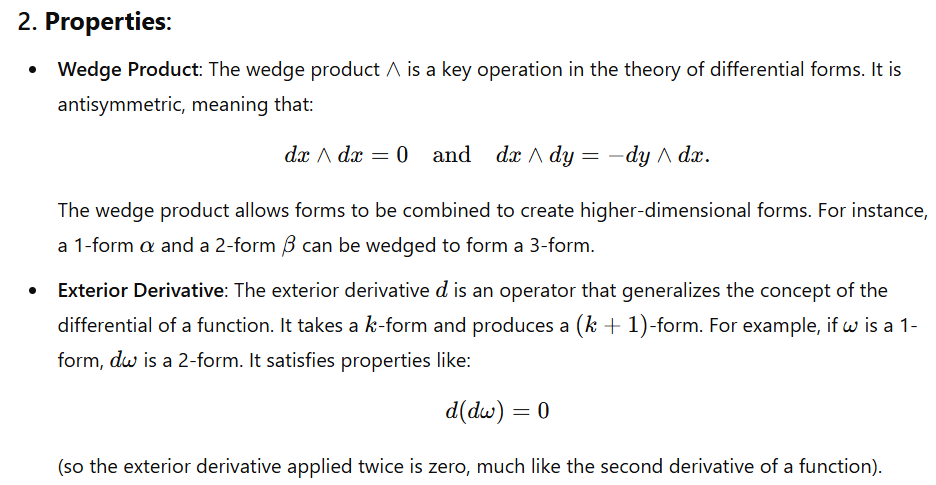
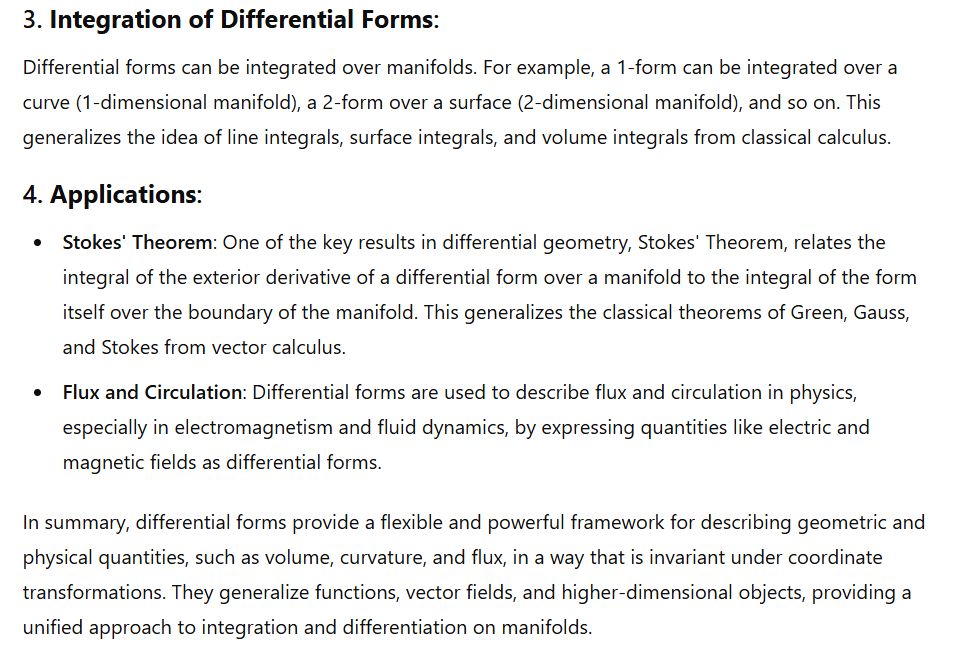
Differential forms: are mathematical objects used in differential geometry, calculus, and topology. They generalize functions, vectors, and other geometric objects and play a crucial role in the study of manifolds, integrals, and differential equations.
A differential form can be thought of as a tool for expressing quantities that change or vary across a manifold, such as areas, volumes, and fluxes, in a way that generalizes the familiar concepts from calculus.

 Naixian Zhang